Prefactor: A Real-Time Evaluation Layer for AI Agents
AI agents are becoming part of more products, workflows, and customer-facing systems. They can answer questions, complete tasks, move information between tools, and make decisions based on context. But as useful as agents can be, they also introduce a challenge that many teams run into quickly: an agent that performs well in testing does not always behave the same way once real users start interacting with it.
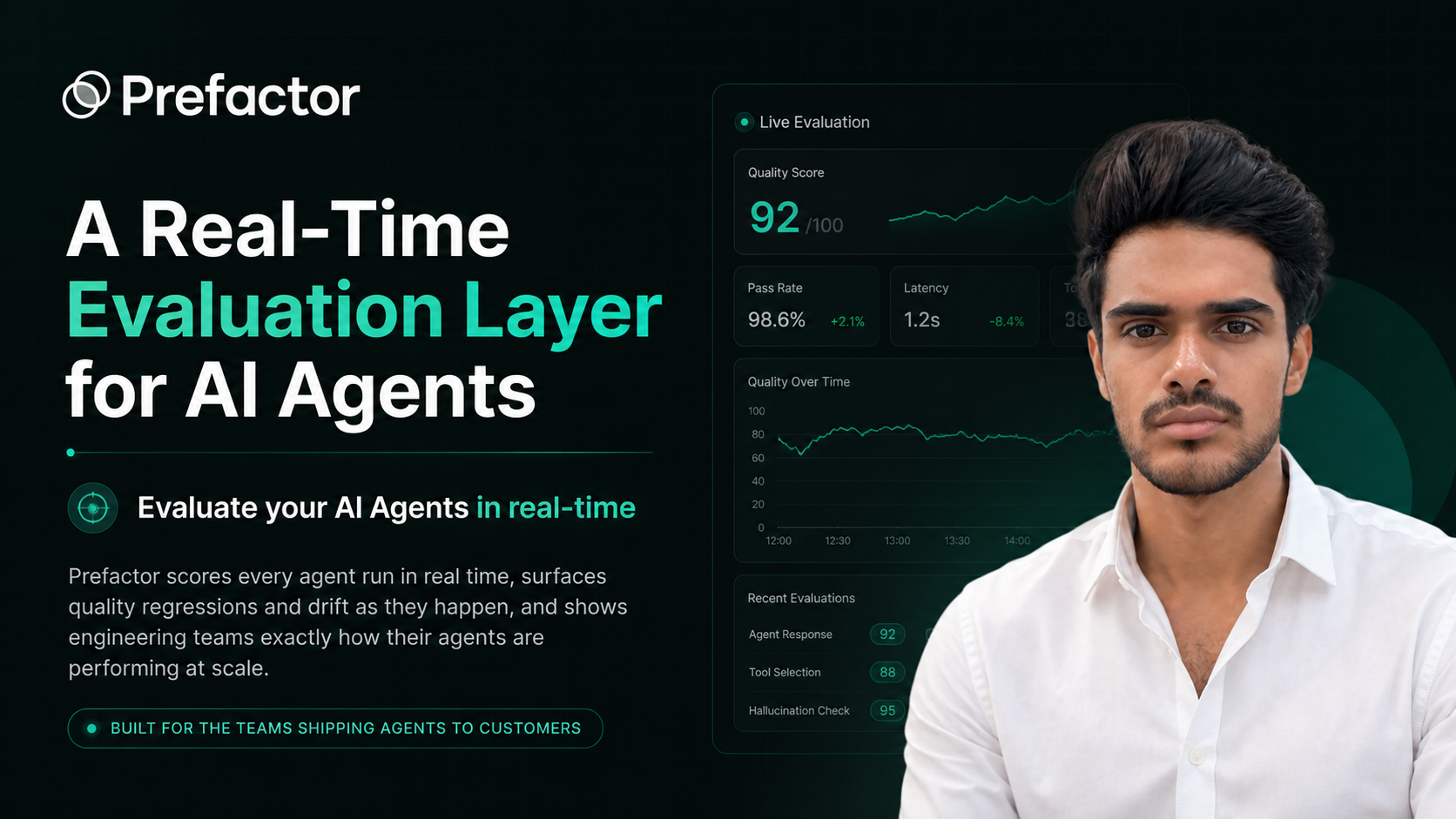
This is the problem Prefactor is focused on. Prefactor is described as an evaluation layer for AI agents, built to score agent runs in real time and help engineering teams understand how their agents are performing in production. The platform is aimed at teams that are shipping agents to customers and need visibility beyond pre-launch evaluations.
You can visit the platform here: https://prefactor.tech
What Prefactor Does
Prefactor is designed to evaluate AI agents as they operate, not only before they are released. The main idea is straightforward: instead of relying only on offline test sets or internal evaluations, teams can monitor every agent run in real time and see where quality issues appear.
In practical terms, Prefactor focuses on helping teams answer questions such as:
- Are agents performing consistently in production?
- Are there quality regressions after a change?
- Is the agent drifting away from expected behavior over time?
- How is the agent performing across real customer interactions?
- Where should the engineering team look when something starts going wrong?
This matters because AI agents are often non-deterministic. The same prompt, tool, model, or workflow can behave differently depending on context, user input, available data, and surrounding system conditions. Traditional software monitoring can show errors, latency, and uptime, but agent quality often requires a different layer of evaluation.
The Gap Between Evals and Production
Many AI teams already run evaluations before deploying an agent. These evaluations may include test prompts, expected outputs, grading rules, or human review. They are useful because they create a baseline for quality before an agent reaches users.
However, production environments are rarely as clean as controlled tests. Real users ask unexpected questions. Inputs may be incomplete, ambiguous, or messy. External tools may return unusual results. Business rules may change. Model behavior can also shift when prompts, system instructions, retrieval logic, or integrations are updated.
This is where the phrase “most agents pass their evals and fail in production” becomes important. Passing a pre-launch evaluation does not guarantee that the agent will continue performing well after deployment. Prefactor positions itself around closing this gap by evaluating agent behavior during actual usage.
Real-Time Scoring for Agent Runs
One of the core ideas behind Prefactor is real-time scoring. Instead of waiting for periodic reviews or manually checking samples, the platform scores agent runs as they happen. This gives teams a way to observe quality continuously.
Real-time scoring can be useful because agent issues are not always obvious from surface-level metrics. A system may be online, fast, and technically successful, while still producing poor answers, taking the wrong action, or failing to complete the task in a way that matches user expectations.
For teams operating customer-facing agents, real-time evaluation can help identify issues sooner. If a recent update causes the agent to respond less accurately, follow the wrong path, or miss important instructions, the team needs a way to detect that pattern quickly.
Surfacing Quality Regressions
Quality regressions happen when a system becomes worse after a change. In traditional software, this might mean a feature breaks after a deployment. In AI agents, regressions can be more subtle. A prompt adjustment, model change, workflow update, or tool modification may improve one area while hurting another.
Prefactor is built to surface these regressions as they happen. That means teams can look for changes in agent performance over time and investigate when scores begin to drop or behavior starts to shift.
This kind of visibility is especially relevant for teams that make frequent changes. AI agent development often involves iteration: adjusting prompts, changing retrieval strategies, improving tool use, and refining task flows. Without an evaluation layer in production, it can be difficult to know whether those changes actually improved the agent for real users.
Monitoring Drift Over Time
Another issue Prefactor highlights is drift. In the context of AI agents, drift can refer to a gradual change in how an agent performs or behaves compared with expectations. Drift may not appear immediately after a deployment. It can develop over time as user behavior changes, input patterns evolve, or connected systems produce different types of data.
For example, an agent that works well for a narrow set of common requests may begin to struggle as more users adopt it for broader use cases. A support agent may perform well for basic questions but become less reliable when handling edge cases. A workflow agent may start making less suitable decisions if upstream data changes.
Prefactor’s role is to help teams detect these shifts. By monitoring agent runs over time, the platform gives engineering teams a clearer view of whether the agent is staying aligned with expected performance.
Who Prefactor Is Built For
Prefactor is described as being built for teams shipping agents to customers. This makes it most relevant for engineering, product, and AI teams that have moved beyond experimentation and are operating agents in real environments.
The platform may be especially relevant in situations where:
- An AI agent is part of a customer-facing product.
- The team needs to measure quality beyond basic system metrics.
- Agent behavior changes after prompt, model, or workflow updates.
- Production performance needs to be monitored continuously.
- There is a need to identify regressions and drift quickly.
- The team wants a clearer picture of agent performance at scale.
It is less about experimenting with a simple chatbot and more about understanding how deployed agents behave when real users depend on them.
Why Agent Evaluation Needs Its Own Layer
AI agents are different from many traditional software systems because they often involve reasoning, language generation, tool use, and multi-step decision-making. A normal application usually follows predefined logic. An agent may interpret instructions, choose a tool, call an API, summarize a result, and decide what to do next.
Because of this, success is not always binary. An agent run may be technically completed but still be low quality. It may answer the question but miss important context. It may take an action but not the best action. It may follow a workflow but create unnecessary friction for the user.
An evaluation layer helps teams look at these qualitative aspects more systematically. Prefactor’s focus on real-time scoring, regressions, and drift reflects this need for ongoing quality measurement.
How Prefactor Fits Into AI Agent Development
AI agent development usually involves several stages. A team designs the agent, tests it internally, runs evaluations, deploys it, and then continues to improve it. Prefactor fits into the production side of that cycle, where the agent is already interacting with real users and generating real outcomes.
Instead of treating evaluation as a one-time step before launch, Prefactor treats it as an ongoing process. This matches how many AI systems are actually maintained. Agents change, models evolve, prompts are updated, and users continue to introduce new cases. Evaluation needs to keep up with that movement.
Final Thoughts
Prefactor is a platform focused on a practical problem in AI agent development: understanding how agents perform once they are running in production. Its main emphasis is on real-time evaluation, quality regression detection, drift monitoring, and performance visibility at scale.
As more teams build and deploy AI agents, the need to evaluate them continuously becomes more important. Pre-launch testing can provide a useful starting point, but production behavior often tells a fuller story. Prefactor is designed around that production reality, giving teams a way to observe agent quality while real interactions are happening.
For anyone exploring the infrastructure around AI agents, Prefactor is worth knowing as an example of how evaluation is moving from static test sets toward ongoing production monitoring.