Hey Noah: An AI Executive Assistant Built Around Founder Follow-Ups
Founders often spend a surprising amount of time on small but important coordination tasks. Scheduling meetings, confirming details, following up after conversations, staying in touch with key people, and making sure nothing gets missed can take up mental space throughout the day.
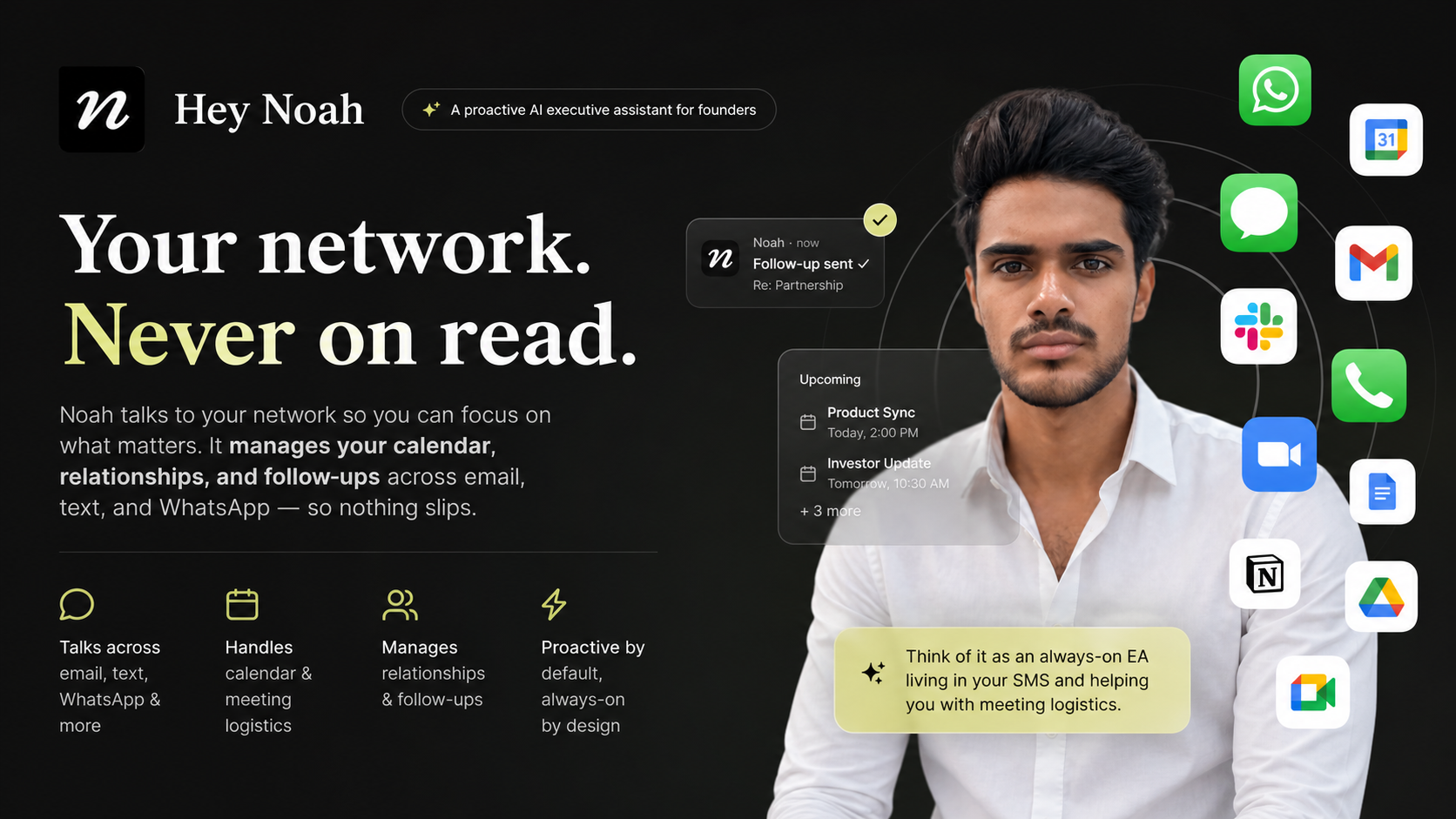
Hey Noah is a platform built around that problem. It describes itself as a proactive AI executive assistant for founders. Instead of acting only as a chatbot that waits for prompts, Noah is positioned as an assistant that can help manage communication and logistics across a founder’s network.
The website is available here: https://heynoah.io
What Is Hey Noah?
Hey Noah is an AI executive assistant designed to help founders manage calendar activity, relationships, and follow-ups. The platform focuses on practical coordination work that usually falls between conversations, meetings, and messaging threads.
The core idea is simple: a founder should not have to manually keep track of every follow-up, meeting detail, and message thread. Noah is designed to operate in the background and help keep those moving pieces organized.
According to its positioning, Noah works across common communication channels such as:
- Text messaging
- SMS-based meeting logistics
This makes the platform different from tools that are limited to a dashboard or a single app. The emphasis is on meeting people where communication already happens.
A Proactive Assistant, Not Just a Chat Interface
Many AI tools are built around a question-and-answer experience. A user opens the tool, types a request, and receives a response. That can be useful for writing, research, summarizing, brainstorming, and analysis.
Hey Noah is described differently. The platform’s tagline points to a proactive AI executive assistant for founders. In practical terms, that means it is intended to help with tasks that involve ongoing communication, timing, and relationship management.
The comparison used by the platform is that Claude talks to you, while Noah talks to your network. This gives a useful way to understand the product category. Noah is not only meant to generate information for the user. It is meant to help coordinate with other people as part of the user’s daily workflow.
What Kind of Work Does Noah Focus On?
Hey Noah appears to focus on the kind of work that executive assistants often handle for busy founders. These are not always complex tasks individually, but they are important because they are frequent, time-sensitive, and easy to forget.
Examples of areas the platform is built around include:
- Calendar management: Helping coordinate meetings, timing, and scheduling-related details.
- Follow-ups: Making sure conversations do not disappear after an initial message or meeting.
- Relationship management: Helping founders stay on top of communication with people in their network.
- Meeting logistics: Supporting the back-and-forth that often happens before meetings are confirmed.
- Cross-channel coordination: Working across email, text, and WhatsApp rather than relying on only one communication tool.
For founders, these small administrative details often create hidden workload. A calendar entry is not just a calendar entry; it may involve finding a time, confirming attendance, sending a location or meeting link, updating details, and following up afterward. Noah is built around reducing the chance that these pieces slip through the cracks.
Why Founders Are the Main Audience
Hey Noah specifically describes itself as being for founders. That focus makes sense because founders often operate with limited time and a high volume of conversations.
A founder may be communicating with investors, customers, team members, candidates, partners, advisors, and service providers in the same week. Some conversations happen by email, others by text, and others through messaging apps. Keeping track of all of it manually can become difficult, especially when the same person is managing product decisions, hiring, fundraising, sales, and daily operations.
Noah is positioned as a tool for that environment. It is not only about creating a cleaner calendar. It is about helping maintain momentum in communication-heavy work.
The Importance of Follow-Ups
Follow-ups are easy to underestimate. A missed follow-up can delay a meeting, weaken a relationship, or cause an opportunity to go cold. At the same time, following up manually with everyone can feel repetitive and distracting.
Hey Noah’s focus on follow-ups is one of the clearest parts of its value proposition. The platform is designed to help ensure that open loops are not forgotten. This can include messages that need a response, meetings that need confirmation, or relationships that require ongoing attention.
In a founder’s workflow, the challenge is not always knowing what to do. Often, the challenge is remembering the right thing at the right time while many other priorities are competing for attention. A proactive assistant is meant to reduce that burden.
How the Communication Layer Matters
One notable part of Hey Noah is its emphasis on everyday communication channels. Many productivity tools require users to open a separate app, update a project board, or maintain a detailed system. That can be useful, but it also creates another place to check.
Noah is described as living in SMS and helping with meeting logistics. That suggests a workflow where the assistant is close to normal messaging behavior, rather than hidden inside a productivity dashboard. The platform also mentions email, text, and WhatsApp, which are common channels for professional and personal coordination.
This matters because communication does not always happen neatly in one place. A founder might schedule a call by email, confirm it by text, and continue the conversation on WhatsApp. A tool designed for this reality needs to pay attention to multiple channels, not just one inbox.
What to Understand Before Using It
As with any AI assistant that works with communication and scheduling, there are a few practical points to understand before using Hey Noah.
- Permissions matter: A tool that helps with email, messaging, or calendars may require access to sensitive information.
- Workflow fit matters: The platform is designed around founders, so it may be most relevant for people who manage many relationships and meetings.
- Channel support should be checked: Since the platform mentions email, text, and WhatsApp, users should review how those channels are connected and managed.
- Pricing and availability should be reviewed directly: Details such as plans, onboarding, and access can change over time.
- AI assistants still require trust and oversight: Any tool that communicates or coordinates on someone’s behalf should be set up carefully.
These points are not unique to Hey Noah. They apply broadly to AI assistants that operate close to a person’s calendar, inbox, and professional network.
Where Hey Noah Fits in the Productivity Landscape
Productivity tools usually fall into a few categories. Some help users write faster. Some help organize tasks. Some manage projects. Others handle calendars or notes. Hey Noah fits into a more specific category: AI-powered executive assistance.
That means the focus is less on creating documents or storing tasks, and more on helping someone move through a busy communication schedule. For a founder, that can involve coordinating with people inside and outside the company while trying to avoid missed messages and delayed responses.
The platform’s description compares it to Tesla Full Self Driving rather than cruise control. The point of that comparison is autonomy. Noah is presented as something that does more than simply remind the user. It is designed to act more actively in the communication process.
Final Overview
Hey Noah is an AI executive assistant built for founders who deal with frequent meetings, ongoing relationships, and scattered communication across multiple channels. Its main focus is helping with calendar management, follow-ups, relationship coordination, and meeting logistics through email, text, WhatsApp, and SMS.
The platform is part of a growing shift from passive productivity tools to proactive AI assistants. Instead of only responding to prompts, Noah is positioned as an always-on assistant that helps founders keep communication moving.
Anyone interested in learning more can visit the platform at https://heynoah.io.