Coldtea.ai: An Agentic IDE Built Around Faster Software Delivery and Production Stability
AI is changing how software teams build and ship products. Code can be generated faster, repetitive tasks can be handled with less manual effort, and teams can move through development cycles at a pace that was difficult to imagine a few years ago. But faster delivery also creates a practical challenge: the quicker teams push changes, the harder it can be to keep production stable.
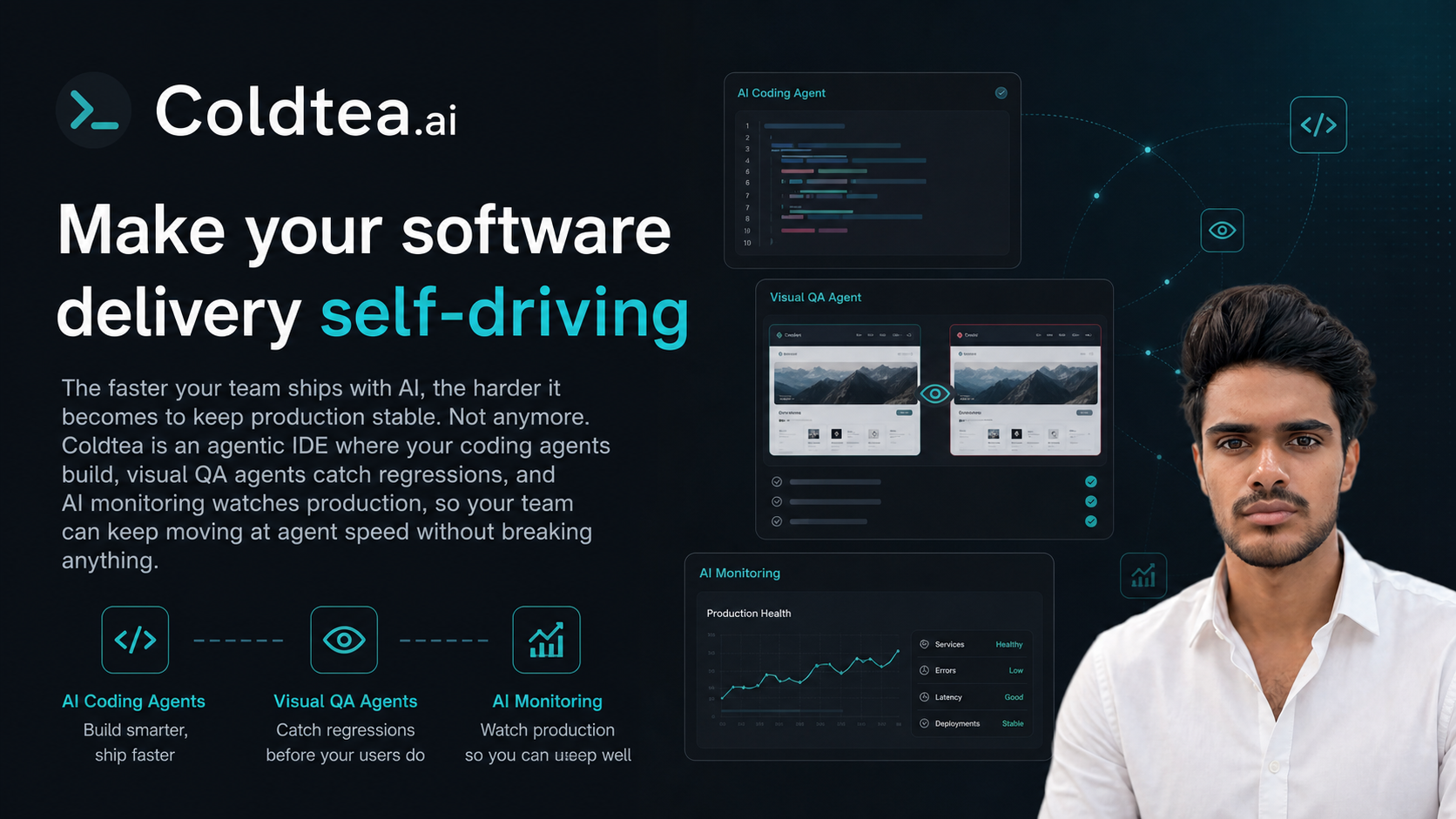
Coldtea.ai is a platform that focuses on that exact problem. It describes itself as an agentic IDE where coding agents help build software, visual QA agents help catch regressions, and AI monitoring watches production. The basic idea is to support software teams that are already moving quickly with AI, while giving them a structure for maintaining quality and stability.
The platform can be found at https://coldtea.ai.
What Is Coldtea.ai?
Coldtea.ai is presented as an AI-powered development environment for software delivery. Instead of focusing only on code generation, it connects multiple parts of the delivery process: building, checking, and monitoring.
This matters because modern software delivery is not only about writing code. A change may look correct in the editor but still cause visual regressions, broken user flows, unexpected production behavior, or issues that only become visible after deployment. Coldtea.ai appears to approach software delivery as a continuous system rather than a single coding task.
Its tagline, “Make your software delivery self-driving,” reflects this broader direction. The platform is built around the idea that AI agents can participate in different stages of delivery, helping teams move faster without leaving stability entirely to manual review.
The Problem It Is Trying to Address
Many teams are already using AI coding tools to speed up development. These tools can help draft features, refactor code, generate tests, explain errors, or assist with implementation details. The result is often a faster development workflow.
However, speed can introduce new pressure. If more code is being created and merged in less time, then quality assurance, review, testing, and monitoring need to keep up. Otherwise, the bottleneck simply moves from writing code to verifying that the software still works as expected.
Coldtea.ai is positioned around this gap. It is not just about producing code faster. It is about supporting the surrounding workflow so that teams can identify issues before or after release, including regressions and production problems.
Key Parts of the Platform
Based on how Coldtea.ai describes its platform, there are three main areas to understand:
- Coding agents: AI agents that assist with building software inside the development environment.
- Visual QA agents: agents that help detect visual regressions and interface-related issues.
- AI monitoring: monitoring that watches production so teams can understand when something may be going wrong after software is shipped.
These areas are closely connected. A coding agent may help create or modify functionality, but visual QA is needed to check whether the user interface still behaves or appears correctly. Production monitoring then adds another layer by observing the software after it is live.
What an Agentic IDE Means in Practice
The term agentic IDE refers to a development environment where AI agents do more than simply respond to prompts. In a traditional coding assistant experience, a developer often asks for a snippet, an explanation, or a change. In an agentic workflow, the AI can take on more structured tasks within the software delivery process.
For Coldtea.ai, the agentic IDE concept appears to combine development assistance with quality and monitoring functions. This gives the platform a broader role than a standard editor extension or single-purpose code assistant.
In practical terms, an agentic IDE can be useful when a team wants AI support across a workflow rather than in isolated moments. That might include building features, checking interface changes, and watching production behavior once changes are released.
Why Visual QA Matters
Visual QA is an important part of software delivery, especially for web apps, dashboards, SaaS tools, ecommerce interfaces, and any product where the user experience depends heavily on layout and design consistency.
A code change can pass automated tests but still cause a visible problem. For example, a button may shift position, a layout may break on a certain screen size, a text block may overflow, or a color change may make an element harder to read. These issues are not always easy to catch with traditional tests alone.
Coldtea.ai includes visual QA agents as part of its stated workflow. The purpose is to help catch regressions, which are problems introduced when something that previously worked stops working correctly. Visual regressions can be particularly difficult when teams are shipping quickly, because they often require careful comparison between previous and current states of the application.
Production Monitoring as Part of the Workflow
Even with careful development and QA, some issues only appear in production. Real users may interact with software in unexpected ways. Different environments, browsers, data states, or usage patterns can expose problems that were not obvious during development.
Coldtea.ai includes AI monitoring that watches production. This suggests that the platform is not limited to pre-release checks. Instead, it considers production behavior part of the software delivery cycle.
This is an important distinction. In many teams, development tools, QA tools, and monitoring tools are separate. Coldtea.ai brings these ideas into one platform concept, where AI is involved not just before release but also after deployment.
Who Coldtea.ai Is Relevant For
Coldtea.ai is most relevant to software teams that are already using AI or planning to use AI more deeply in their development process. It is especially aligned with teams that want to increase delivery speed but are also concerned about regressions and production stability.
It may be particularly relevant for:
- Product teams shipping frequent updates
- Engineering teams using AI coding agents
- Startups that need to move quickly with limited resources
- Teams maintaining user-facing web applications
- Developers who want AI support beyond code generation
- Organizations looking at AI-assisted QA and monitoring workflows
The platform is not described as a general project management tool or a simple code editor. Its focus is software delivery with AI agents, visual QA, and production monitoring working together.
How It Fits Into Modern Development
Modern software delivery has become increasingly continuous. Teams write code, review it, test it, deploy it, monitor it, and then repeat the cycle. AI coding tools can speed up the first part of this process, but that creates a need for the rest of the cycle to become more responsive too.
Coldtea.ai fits into this shift by treating software delivery as a connected system. The platform’s description suggests a workflow where AI is not only helping developers write software but also helping teams detect issues and maintain stability as changes move toward production.
This kind of approach reflects a broader trend in development: AI is moving from being a code assistant to becoming part of the engineering workflow itself. That includes tasks that traditionally required manual QA, production investigation, or repeated checks across the release process.
Things to Understand Before Exploring It
Coldtea.ai is built around a specific idea: software teams are moving faster with AI, and delivery systems need to adapt. Anyone exploring the platform should understand that its value is tied to that context.
Some useful questions to consider while learning more about it include:
- How does the platform fit into an existing development workflow?
- What kinds of applications and repositories does it support?
- How do the coding agents interact with developers?
- How are visual regressions detected and reviewed?
- What does production monitoring track?
- How does the platform handle collaboration among team members?
These are practical questions for any team evaluating an AI-based development platform. They help clarify whether the tool aligns with the team’s current process, technical stack, and delivery needs.
Final Thoughts
Coldtea.ai is a platform focused on making AI-assisted software delivery more stable. Its main concept is straightforward: as coding agents help teams build faster, visual QA agents and AI monitoring help reduce the risk of shipping broken experiences or missing production issues.
Rather than presenting AI only as a way to generate code, Coldtea.ai places it across the delivery pipeline. That includes development, regression detection, and production monitoring. For teams interested in agent-based software workflows, it is a platform worth understanding as part of the changing landscape of software development tools.
More information is available on the official website: https://coldtea.ai.