
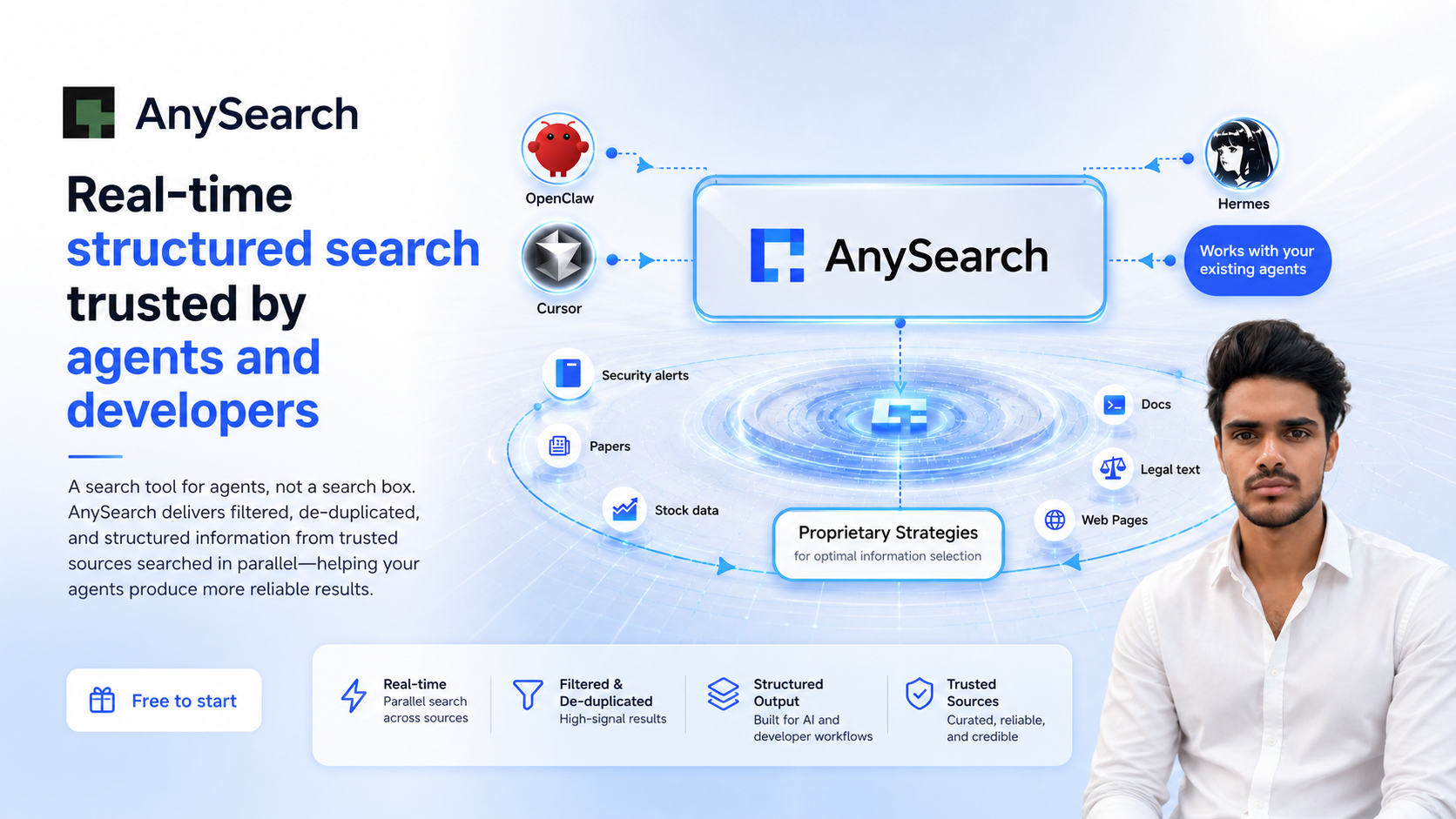
AnySearch: A Structured Search Layer for AI Agents and Developer Workflows
AnySearch is a platform built around that specific need. It describes itself as a real-time structured search tool trusted by agents and developers. Instead of being positioned as a traditional search engine for browsing the web manually, it is designed to help AI agents receive filtered, de-duplicated, and structured information from trusted sources searched in parallel.
The platform can be explored at https://www.anysearch.com.
What Is AnySearch?
AnySearch is a search tool made for AI agents and developer use cases. Its core idea is simple: AI systems can only produce useful responses when they have access to useful information. If an agent receives outdated, duplicated, messy, or poorly structured results, the output can become less reliable.
AnySearch aims to improve this input layer. It gives agents access to real-time search results that are filtered and structured before being passed along. This makes it different from a basic web search page where a human user is expected to evaluate everything manually.
In practical terms, AnySearch sits closer to an information retrieval layer than a standard consumer-facing search box. It is intended to support applications where search results need to be consumed programmatically, especially by AI agents that depend on external information to complete tasks.
Why Structured Search Matters for AI Agents
AI agents often need to gather information before completing a task. This may involve checking current data, comparing sources, collecting facts, or finding relevant references. The quality of the agent’s final response depends heavily on the quality of the information it receives.
Traditional search results can contain several challenges for agents:
- Duplicate information: Multiple pages may repeat the same facts, which can make results noisy.
- Unstructured content: Web pages are often designed for human reading, not direct machine use.
- Mixed source quality: Results can include useful pages alongside less relevant or less reliable ones.
- Time-sensitive information: Some tasks require current information rather than static knowledge.
- Context overload: Too many raw results can make it harder for an agent to identify what is actually relevant.
AnySearch focuses on addressing these issues by providing filtered, de-duplicated, and structured information. That approach is especially relevant for agents that need to make use of search results without a human manually sorting through every link.
How AnySearch Is Different from a Regular Search Box
A regular search box is usually built around a human workflow. A person types a query, scans the results, opens pages, evaluates sources, and decides what to trust. This process works because humans bring judgment, context, and patience to the search experience.
AI agents need a different workflow. They need information that is already prepared in a useful format. They also need the search process to be efficient enough to fit into automated tasks. AnySearch is built around this agent-focused model.
The distinction can be summarized this way:
- Traditional search: Designed for people to browse and interpret results.
- AnySearch: Designed to provide structured information that agents and developers can use more directly.
This does not mean the platform replaces all forms of search. Rather, it serves a specific role in AI and developer workflows where structured search results are more useful than a list of links.
Key Ideas Behind AnySearch
Based on its positioning, AnySearch is centered around a few important concepts that are becoming more relevant as AI tools become more common.
Real-Time Search
Many AI models have limits when it comes to current information. If an agent needs up-to-date data, it has to connect to external sources. AnySearch is built for real-time structured search, which means it is focused on helping agents work with information that is not limited to static training data.
Structured Results
Structure matters because agents work better when information is organized. Instead of receiving a messy collection of pages or snippets, an agent can use structured information more effectively in its reasoning or response generation process.
Filtered Information
Search results are not always equally useful. Filtering helps reduce irrelevant material so that the agent can focus on content that is more likely to be helpful for the task.
De-Duplication
Duplicate content can create confusion or unnecessary repetition. De-duplicating results helps make the information set cleaner and more efficient.
Trusted Sources Searched in Parallel
AnySearch is described as searching trusted sources in parallel. This is important for workflows where reliability and speed both matter. Searching multiple trusted sources at the same time can help an agent gather a broader view without relying on a single result stream.
Who Might Find AnySearch Useful?
AnySearch is mainly relevant to people working with AI agents, automation, and developer tools. It may be especially useful in contexts where applications need access to external information in a structured way.
Potential audiences include:
- AI agent builders who need a search layer for retrieving current information.
- Developers building tools that depend on structured search results.
- Automation teams creating workflows where agents need reliable context.
- Product builders experimenting with AI features that require external data access.
- Technical researchers exploring how search can improve agent performance.
The platform is not described as a general productivity app for everyday manual searching. Its main focus appears to be search for agents and developers rather than a consumer search experience.
Where It Fits in an AI Workflow
In many AI systems, there is a gap between the user’s request and the model’s answer. The model may need outside information to respond properly. This is where a search layer can become important.
A simplified workflow might look like this:
- A user or system gives an AI agent a task.
- The agent determines that it needs external information.
- AnySearch searches trusted sources in parallel.
- The results are filtered, de-duplicated, and structured.
- The agent uses that information to produce a more informed response.
This kind of workflow is useful because it treats search as part of the agent’s reasoning process rather than a separate manual activity. The goal is not just to find pages, but to provide the agent with usable context.
Free to Start
AnySearch is described as free to start. That can be helpful for developers and teams that want to explore how structured search fits into their workflow before making a larger commitment. For anyone evaluating tools in this category, it is still important to review the platform directly for current details about access, usage limits, features, and pricing.
Things to Understand Before Using It
AnySearch is part of a broader shift in how search is being used. Instead of search being only a destination for people, it is becoming infrastructure for AI systems. That shift creates new expectations around format, reliability, freshness, and source quality.
Before using a platform like AnySearch, it helps to be clear about the use case. Some useful questions include:
- Does the agent need real-time information?
- Is the task affected by duplicate or low-quality results?
- Does the application need structured data rather than a list of links?
- Are trusted sources important for the workflow?
- Will the search results be used automatically by an AI system?
If the answer to these questions is yes, then a structured search layer may be relevant to the workflow. If the goal is simply to manually browse the web, a conventional search engine may be enough.
Final Overview
AnySearch is a real-time structured search platform designed for AI agents and developers. Its focus is not on replacing the familiar search box for everyday browsing, but on giving agents cleaner and more usable information. By emphasizing filtered, de-duplicated, and structured results from trusted sources searched in parallel, it addresses a practical problem in AI workflows: agents need better input to produce more reliable output.
As AI agents become more common in personal and professional tools, the quality of their information sources will matter more. Platforms like AnySearch show how search is evolving from a human-facing experience into a structured layer that can support automated systems.
You can visit the platform here: https://www.anysearch.com.