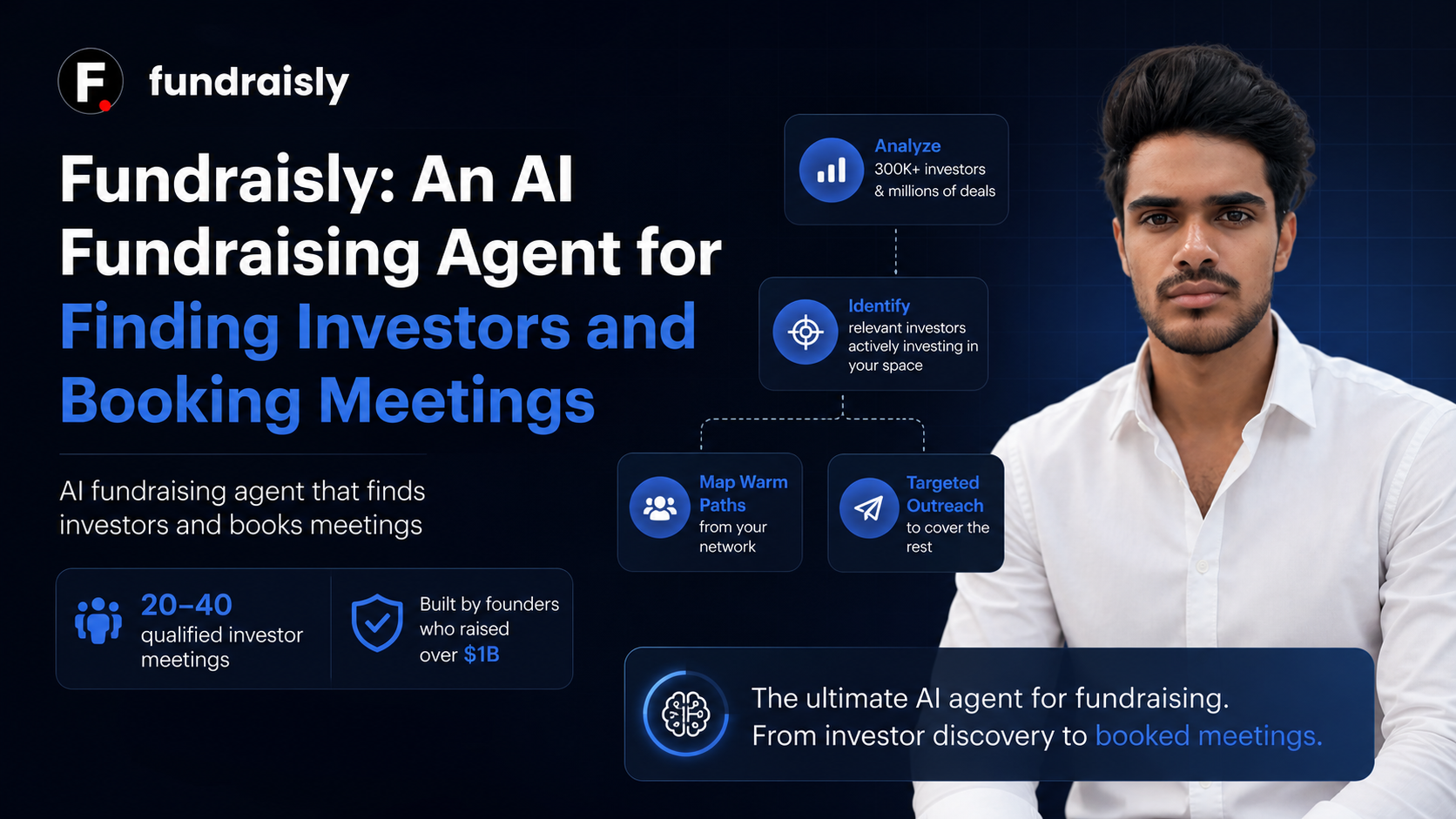
Fundraisly: An AI Fundraising Agent for Finding Investors and Booking Meetings
Fundraising can take a large amount of time for founders. Building investor lists, researching who is actively investing, finding the right partner at each firm, checking portfolio fit, looking for warm introductions, and managing outreach can quickly become a full-time process.
Fundraisly is a platform built around this problem. It is described as an AI fundraising agent that helps founders find relevant investors and book meetings. Instead of treating fundraising as a manual spreadsheet exercise, Fundraisly uses AI to analyze investor data, identify suitable matches, map warm paths through a founder’s own network, and support targeted cold outreach where warm introductions are not available.
The platform can be found at https://fundraisly.com.
What Is Fundraisly?
Fundraisly is an AI-based fundraising agent for startup founders. Its core purpose is to help companies discover investors who are more likely to be relevant for their specific business, stage, category, and fundraising goals.
According to its positioning, Fundraisly analyzes more than 300,000 investors and millions of deals. This gives the platform a broad base of fundraising and investment activity to work from when identifying potential investor matches.
Rather than simply giving founders a generic investor database, Fundraisly focuses on a more complete workflow:
- Identifying investors who are relevant to the company’s space
- Finding investors who are actively investing
- Mapping possible warm introduction paths from the founder’s existing network
- Supporting targeted cold outreach when warm paths are not available
- Helping founders work toward qualified investor meetings
The platform is designed for the fundraising process from the founder’s side, especially for teams that need to manage investor discovery and outreach without spending all their time on manual research.
The Problem Fundraisly Is Trying to Solve
Many founders begin fundraising by creating a long list of venture capital firms, angel investors, accelerators, or strategic investors. The challenge is that a long list does not always mean a useful list.
Some investors may not invest in the founder’s sector. Others may only invest at a different stage. Some may have already invested in a competitor. Some may not be actively making new investments. In many cases, the founder also needs to know which individual partner or decision-maker is most relevant, not just the name of the firm.
This can create several common fundraising challenges:
- Too much manual research: Founders may spend hours checking websites, portfolios, LinkedIn profiles, funding announcements, and databases.
- Low-quality outreach lists: Broad investor lists often contain investors who are not a good fit.
- Unclear warm introduction paths: Founders may have potential connections to investors but not know where those paths exist.
- Cold outreach uncertainty: When there is no warm intro, founders still need to decide whom to contact and how to prioritize.
- Meeting quality issues: The goal is not just more meetings, but meetings with investors who are actually relevant.
Fundraisly is built around making this process more structured and data-driven.
How Fundraisly Works
Fundraisly’s workflow can be understood in three main parts: investor analysis, warm path mapping, and outreach support.
1. Investor Analysis
The platform analyzes a large pool of investor and deal data to identify investors who may be relevant to a startup’s fundraising needs. This includes looking at investors across a wide range of funding activity and filtering for those who appear to match the company’s space.
This matters because fundraising is usually not about contacting as many investors as possible. It is about finding investors whose investment behavior suggests they may understand the market, fund the stage, and have a reason to engage.
For example, a founder raising for a B2B software company would usually want to focus on investors with activity in similar categories, related business models, or comparable deal stages. Fundraisly is designed to help with this type of matching.
2. Warm Introduction Mapping
Warm introductions are often important in fundraising because investors are more likely to take a meeting when the introduction comes through someone they already know or trust. However, founders do not always have a clear view of their full network.
Fundraisly maps warm paths from a founder’s own network. The idea is to help founders see where a connection may exist between them and a relevant investor.
This can help founders answer questions such as:
- Who in my network may know this investor?
- Is there a possible path to a specific partner or fund?
- Which investors should be prioritized because there is a warmer route?
- Where should I use introductions instead of cold outreach?
Warm path mapping can be especially useful when a founder has a larger network than they realize, but has not organized it around a fundraising process.
3. Targeted Cold Outreach
Not every investor will have a warm path. Fundraisly also covers the remaining outreach with targeted cold outreach. This is different from sending a broad, generic message to a large number of investors.
Targeted cold outreach depends on relevance. If the platform has identified investors who are actively investing in a founder’s space, cold outreach can be more focused than a general campaign.
The platform’s stated outcome is to help founders get 20 to 40 qualified investor meetings. The important word here is qualified, because fundraising conversations are more useful when the investor is a reasonable match for the company.
Who Fundraisly Is For
Fundraisly is mainly relevant for startup founders and founding teams preparing for or actively running a fundraising process. It may be especially relevant for companies that need a more organized way to identify and contact investors.
The platform may fit teams that are dealing with situations like:
- Preparing to raise a seed, Series A, or later round
- Trying to build a focused investor target list
- Looking for warm introduction paths through an existing network
- Needing support with targeted investor outreach
- Wanting to reduce time spent on manual investor research
- Seeking a more structured approach to booking investor meetings
It is not positioned as a replacement for the founder’s fundraising story, business fundamentals, pitch deck, or investor conversations. Instead, it focuses on the discovery and outreach side of the fundraising process.
What Makes the Platform Notable
Several aspects of Fundraisly stand out from the basic description of the platform.
- Large investor and deal coverage: The platform analyzes more than 300,000 investors and millions of deals.
- Focus on active relevance: It aims to identify investors who are actively investing in a company’s space.
- Network-based warm paths: It uses the founder’s own network to find possible introduction routes.
- Cold outreach support: It also handles outreach where warm introductions are not available.
- Meeting-oriented workflow: The process is designed around booking qualified investor meetings, not just building a list.
The platform was built by founders who have raised more than $1 billion, which suggests the product is shaped by experience with fundraising workflows. The platform’s focus is not only on data, but also on the practical steps that happen between identifying an investor and getting into a meeting.
Why Investor Relevance Matters
One of the biggest inefficiencies in fundraising is contacting investors who are not a fit. Even if an investor is well-known or active in venture capital, they may not be the right match for a specific startup.
Relevance can depend on many factors, including:
- Industry or sector
- Business model
- Company stage
- Geography
- Check size
- Portfolio strategy
- Recent investment activity
- Competitive conflicts
A founder can lose a lot of time chasing conversations that were unlikely from the beginning. A better-matched investor list can make the fundraising process more focused and easier to manage.
Fundraisly’s approach is based on the idea that the quality of investor targeting matters as much as the volume of outreach.
Things to Keep in Mind
Fundraisly can help with investor discovery and outreach, but fundraising still depends on many factors outside any platform’s control. A company’s traction, market, team, timing, pitch, valuation, and fundraising environment all influence investor interest.
Founders using a tool like this would still need to prepare the core fundraising materials, including:
- A clear fundraising narrative
- A strong pitch deck
- Financial and operating metrics
- A concise explanation of the market opportunity
- A plan for follow-up conversations
- A process for tracking investor feedback
Fundraisly appears to focus on helping founders reach the right investors more efficiently. The rest of the fundraising process still requires preparation and execution by the founding team.
Final Overview
Fundraisly is an AI fundraising agent designed to help founders identify relevant investors, map warm introduction paths, and manage targeted outreach. It analyzes a large investor and deal dataset, then uses that information to support a more focused fundraising process.
For founders, the main value of a platform like this is structure. Instead of starting with a broad investor spreadsheet and manually narrowing it down, Fundraisly is built to help identify who may be relevant, how to reach them, and where warm paths may exist.
More information about the platform is available at https://fundraisly.com.