Prelint: A Practical Look at Preventing Product Drift in AI-Written Code
AI-assisted development has changed the pace of software work. Code can now be generated, edited, refactored, and reviewed much faster than before. That speed can be useful, but it also creates a familiar problem for product and engineering teams: the code may be technically valid while still moving away from the decisions the team has already made.
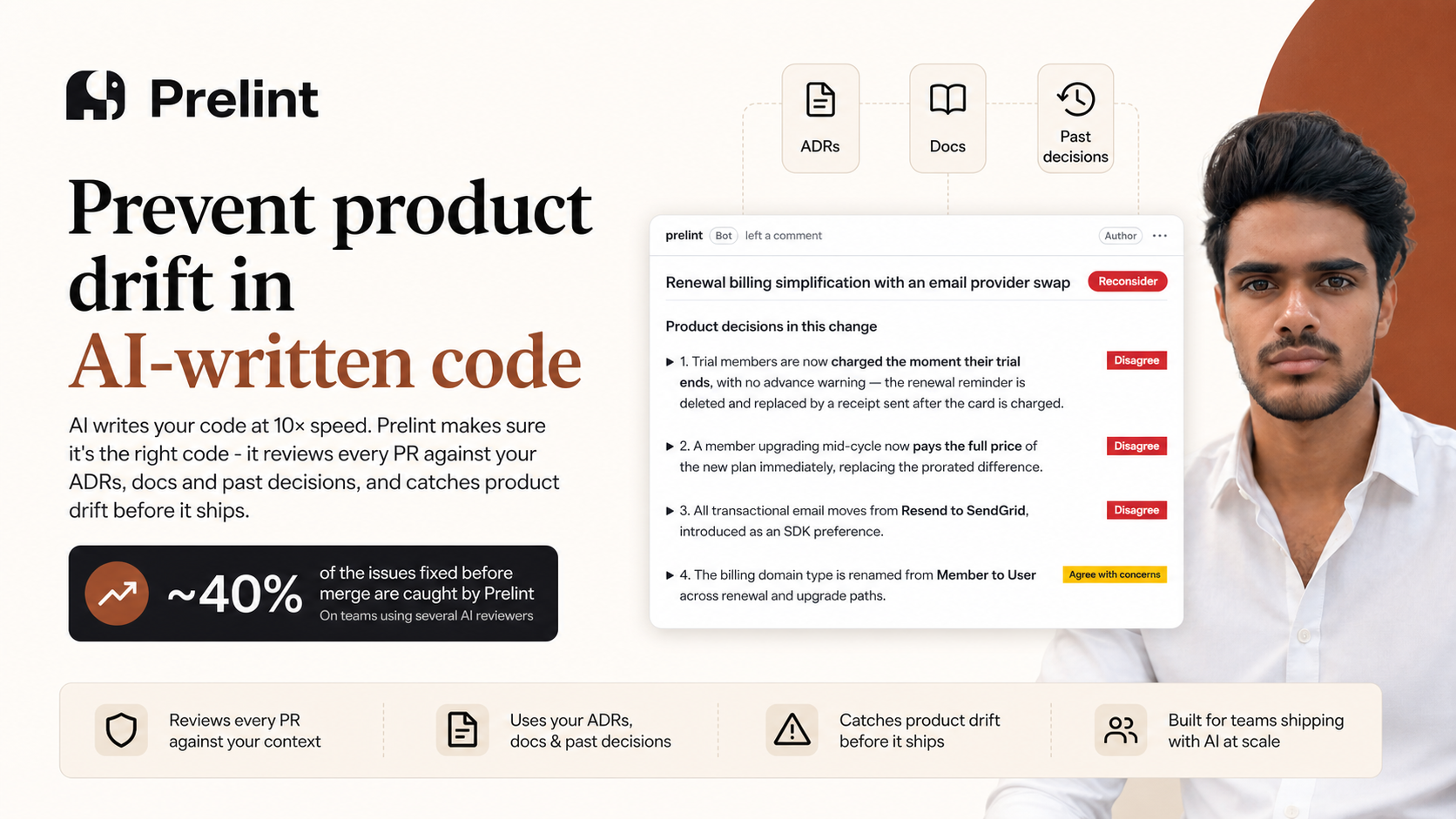
This is the space where Prelint fits in. Prelint is a platform designed to help teams prevent product drift in AI-written code. Its purpose is not just to check whether code compiles or follows generic patterns. Instead, it reviews pull requests against a team’s own architecture decision records, documentation, and past decisions so that the code being merged stays aligned with the product direction.
You can find the platform at https://prelint.com.
What Prelint Is
Prelint is a review layer for pull requests. It looks at incoming code changes and compares them with the context that already exists inside a team: ADRs, docs, and previous product or technical decisions.
The tagline of the platform is Prevent product drift in AI-written code. That captures the main idea clearly. AI can write code at high speed, but speed alone does not guarantee that the output reflects the intent behind the product. Prelint is built to help check whether the work being proposed matches what the team has already agreed to build.
In simple terms, Prelint helps answer questions like:
- Does this pull request follow the product decisions already documented?
- Is the implementation moving away from the intended architecture?
- Does the AI-generated code conflict with past decisions?
- Are there signs that the code is solving the wrong version of the problem?
The Problem: Product Drift
Product drift happens when the product slowly moves away from its intended direction. It can occur for many reasons: unclear requirements, outdated documentation, rushed implementation, or code that solves an immediate task while ignoring broader decisions.
With AI-written code, the risk can become more visible. AI tools can produce code quickly, but they may not automatically understand all the context behind a team’s decisions. A change might look reasonable in isolation but still be inconsistent with the product’s long-term direction.
For example, a team may have already decided how a certain workflow should behave, how data should be structured, or which architectural pattern should be used. If a pull request introduces a different approach without recognizing those earlier decisions, the result may be product drift.
Prelint focuses on catching that kind of mismatch before code is merged.
How Prelint Fits Into the Pull Request Process
Prelint reviews every pull request against the materials that define how the product should evolve. These include:
- ADRs: Architecture decision records that explain important technical choices.
- Docs: Product, engineering, or internal documentation that describes expected behavior and direction.
- Past decisions: Previous choices that may not always be obvious from the code alone.
This matters because code review is not only about syntax, performance, or test coverage. A pull request can pass automated checks and still be misaligned with the product. Prelint is designed to add a contextual review step that looks for this kind of alignment issue.
The goal is to catch problems before merge, when they are usually easier to fix. Once drift reaches production, it can become harder to identify and more expensive to unwind.
Why ADRs and Documentation Matter
Many teams create documentation and decision records, but those materials are not always actively used during day-to-day development. They may sit in a folder, wiki, or repository while new work moves forward quickly.
Prelint treats those materials as part of the review context. This is important because documentation only helps if it is connected to the work being done. When pull requests are checked against ADRs and docs, the team has a better chance of noticing when a proposed change does not match what was previously agreed.
This is especially relevant in environments where AI tools are used to generate or edit code. The AI may produce something plausible, but the team still needs a way to verify that the change fits the product’s specific rules, constraints, and history.
What Prelint Is Designed to Catch
Prelint is positioned around catching product drift before it ships. In practice, that means looking for differences between a proposed code change and the team’s existing decisions.
The kinds of issues this type of review is meant to surface may include:
- Code that conflicts with documented product behavior.
- Implementation choices that ignore prior architectural decisions.
- Changes that solve a task in a way that does not match the intended product direction.
- Pull requests that introduce inconsistencies with past decisions.
- AI-generated changes that appear correct but lack the right product context.
This does not replace human judgment. Instead, it adds another layer of review focused on context. Human reviewers still need to decide what should be changed, accepted, or discussed further.
How It Relates to AI Code Reviewers
Many teams now use more than one AI tool in their development workflow. Some tools help write code. Others assist with review, testing, or refactoring. Prelint sits in a specific part of that landscape: it focuses on whether the code matches the team’s own documented decisions.
For teams using several AI reviewers, Prelint reports that around 40% of the issues fixed before merge are caught by Prelint. That figure helps explain the role it is trying to play. It is not only looking for generic code issues. It is looking for problems that appear when code is compared with the team’s product and architectural context.
Who Might Find Prelint Relevant
Prelint is most relevant to teams where product and technical decisions are important to preserve over time. This can include teams that:
- Use AI tools to generate or modify code.
- Maintain architecture decision records.
- Rely on internal documentation to guide implementation.
- Work with multiple contributors across product and engineering.
- Want pull requests to reflect previous decisions, not just current tasks.
It may also be relevant in situations where the pace of development has increased and the team wants stronger checks around consistency. Faster code generation can create more review work, especially when reviewers need to remember decisions made weeks or months earlier.
Points to Understand Before Exploring It
Prelint is built around the idea that a team already has decisions and documentation that can be used as review context. If a team does not maintain ADRs, docs, or clear records of past decisions, there may be less material for a tool like this to compare against.
It is also worth understanding the distinction between code correctness and product alignment. Prelint is not described as a general-purpose compiler, test runner, or security scanner. Its focus is on preventing product drift by reviewing pull requests against the team’s own context.
That makes the quality of the underlying documentation important. Clear decisions, current docs, and well-maintained records can make contextual review more meaningful.
Website
More information about the platform is available on the Prelint website: https://prelint.com.
Final Thoughts
Prelint addresses a specific challenge that comes with faster AI-assisted development: making sure the code being produced is not only functional, but also aligned with the product’s existing direction.
By reviewing pull requests against ADRs, documentation, and past decisions, it gives teams a way to catch product drift before merge. For teams that are already using AI to write or review code, this kind of contextual review can help keep development connected to the decisions that shaped the product in the first place.