oqoqo: A Practical Look at Evals and Custom Benchmarks for AI Agents
As AI agents become more common in everyday software workflows, one question keeps coming up: how well do they actually perform on real tasks?
It is one thing to test a model with a general benchmark or a simple prompt. It is another thing to understand whether an AI agent can use a specific product, complete a multi-step task, avoid unnecessary token usage, or handle the kind of friction that appears in real interfaces.
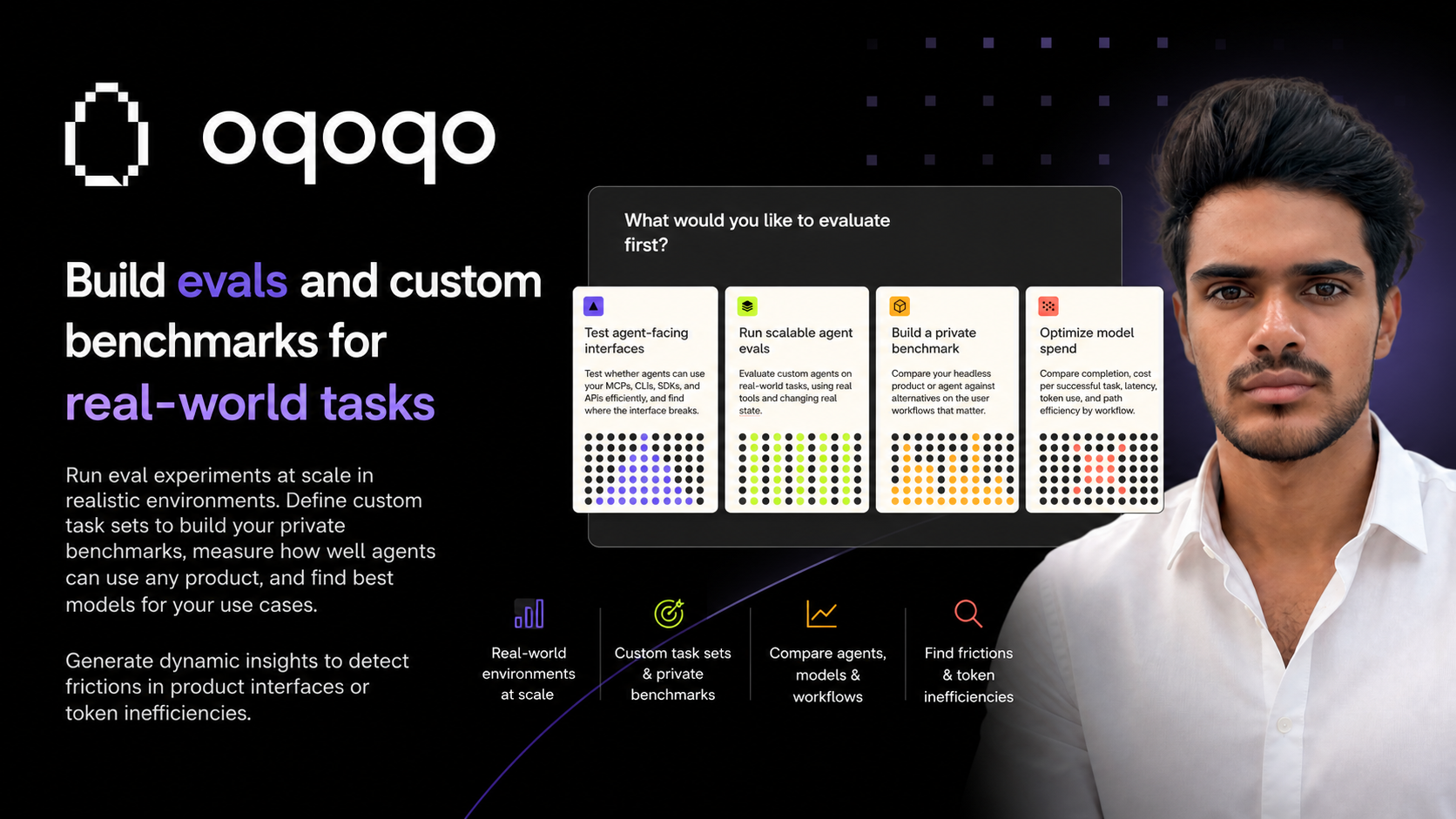
oqoqo is a platform built around that problem. Its focus is on helping teams build evals and custom benchmarks for real-world tasks. Instead of relying only on broad public benchmarks, oqoqo is designed to support private task sets, realistic testing environments, and experiments that measure how agents perform in practical situations.
The platform can be found at https://oqoqo.ai.
What Is oqoqo?
oqoqo is a platform for running evaluation experiments at scale. In this context, “evals” refers to structured tests used to measure how AI systems behave on specific tasks. These tasks can be designed to reflect real user workflows, product interactions, or internal business processes.
The platform is centered on custom benchmarks rather than one-size-fits-all evaluation. This matters because many organizations have use cases that are too specific to be measured properly by public benchmark scores alone. A model may perform well on general reasoning tests but still struggle with a company’s actual product flow, terminology, interface, or task sequence.
oqoqo is built to help evaluate these kinds of situations by allowing teams to define task sets, run experiments, and compare performance in environments that are closer to real usage.
Why Custom Benchmarks Matter
AI model evaluation is often discussed in terms of public leaderboard results. These scores can be useful, but they do not always answer the more practical question: Which model works best for this specific task?
For example, a team may want to know whether an agent can:
- Navigate a product interface correctly
- Complete a multi-step workflow without getting stuck
- Use available tools or product features in the expected way
- Handle realistic input instead of simplified examples
- Finish a task without excessive token usage
- Perform consistently across repeated runs
These questions are difficult to answer with generic benchmarks. Custom benchmarks make it possible to define the exact tasks that matter to a team or product. oqoqo’s approach is built around this idea: create private task sets, test agents in realistic conditions, and use the results to understand performance more clearly.
Running Eval Experiments at Scale
One of the main purposes of oqoqo is to run eval experiments at scale. This means teams can test more than a single prompt or isolated example. They can define many tasks, run repeated evaluations, and compare outcomes across models, agents, or configurations.
At scale, evaluation becomes more useful because patterns start to appear. A single failed task may not say much on its own. But repeated failures across similar workflows can highlight a real weakness. Similarly, if one model consistently completes a product task with fewer steps or lower token usage, that can be useful when choosing which model to use for a specific application.
For teams building with AI agents, scaled evaluation can support more structured decision-making. Instead of choosing a model only because it is popular or performs well on general tests, teams can measure performance against their own tasks.
Testing Agents in Realistic Environments
Another important part of oqoqo is its emphasis on realistic environments. AI agents often need to interact with products, tools, or interfaces rather than simply answer a question in a chat box. This creates additional challenges.
An agent may need to understand where to click, which field to fill, what information to extract, or how to recover when something unexpected happens. These are not always captured in traditional model benchmarks.
By evaluating agents in realistic settings, teams can get a clearer picture of how they perform in workflows that resemble actual use. This is especially relevant for products that expect agents to operate inside apps, complete tasks for users, or assist with business processes.
Building Private Task Sets
oqoqo allows users to define custom task sets to build private benchmarks. A private benchmark is useful when the tasks are specific to an organization, product, workflow, or user need.
Private benchmarks can help teams avoid relying only on external measurements. They can also keep the evaluation focused on what matters most internally. For example, a company may care less about whether a model performs well on a broad academic-style benchmark and more about whether it can correctly complete 50 product-related workflows.
These private task sets can be used to compare different models or agent setups. Over time, they can also become a stable way to check whether updates improve or reduce performance.
Finding the Best Models for Specific Use Cases
Different models can behave very differently depending on the task. One model may be strong at planning, another may be more efficient, and another may interact better with certain interfaces or tools.
oqoqo is designed to help identify which models are better suited for particular use cases. This is a practical approach because there is rarely a single best model for every situation. The better question is often: which model performs best for this workflow, under these conditions, at this cost or level of efficiency?
By running benchmark tasks across models, teams can compare performance in a more grounded way. This can help with model selection, agent design, and ongoing evaluation as new models become available.
Detecting Product Friction
oqoqo also focuses on generating dynamic insights that can detect friction in product interfaces. This is an interesting part of agent evaluation because an agent’s failure is not always caused by the model itself.
Sometimes the issue may be the product interface. A workflow may be unclear. A button may be hard to identify. A form may require information in a confusing order. Instructions may be ambiguous. If agents repeatedly struggle with the same part of a product, that pattern may point to interface friction.
This can be useful beyond AI testing. If an agent has trouble completing a task because the interface is difficult to interpret, human users may also experience similar friction. Evaluation results can therefore provide clues about where a product experience may need to be reviewed.
Understanding Token Inefficiencies
Another area oqoqo highlights is token inefficiency. In AI systems, token usage affects cost, speed, and sometimes the quality of interaction. An agent that uses far more tokens than necessary may still complete a task, but it may be less efficient in production.
Token inefficiency can appear in different ways:
- Overly long reasoning paths
- Repeated attempts at the same step
- Unnecessary tool calls or interface actions
- Verbose outputs when concise responses are enough
- Confusion that causes the agent to loop or restart
By identifying these patterns, teams can better understand where an agent may be wasting tokens and where a workflow could be optimized.
Who Might Find oqoqo Useful?
oqoqo is most relevant for people and teams working with AI agents in real products or operational workflows. This may include product teams, AI engineers, researchers, automation teams, or companies comparing different models for internal use cases.
It may be especially relevant when a team needs to move beyond simple demos and evaluate whether an agent can perform reliably in more realistic conditions.
Final Thoughts
oqoqo addresses a practical challenge in AI adoption: evaluating agents on the tasks that actually matter. Its focus on custom benchmarks, realistic environments, model comparison, product friction, and token efficiency makes it part of a growing category of tools built around applied AI evaluation.
As more products begin to include AI agents, structured evaluation will likely become more important. Platforms like oqoqo help make that process more organized by giving teams a way to define their own tasks, run experiments, and understand how agents behave in real-world workflows.