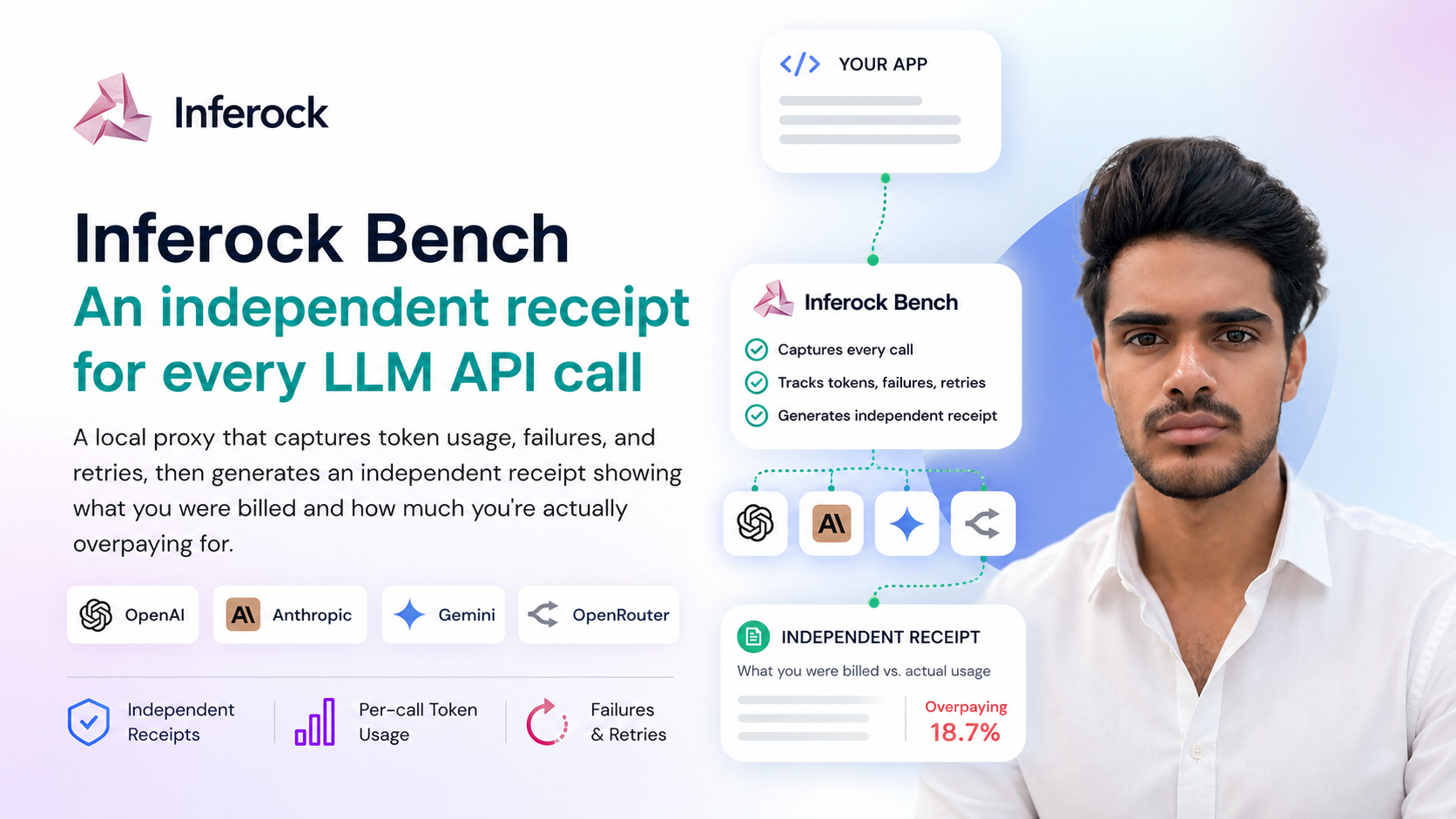
Inferock Bench: A Local Way to Track LLM API Calls and Billing Details
As more applications connect to large language model APIs, it becomes more important to understand what each request actually costs. A single API call may look simple from the outside, but behind it there can be prompt tokens, completion tokens, retries, failed attempts, and billing calculations that are not always easy to inspect from inside the application itself.
Inferock Bench is a local proxy built for this exact kind of visibility. Its tagline is simple: An independent receipt for every LLM API call. In practical terms, it sits between an application and supported LLM API endpoints, captures what happens during each call, and produces a receipt that helps show what was billed and where overpayment may be happening.
The project is available on GitHub at https://github.com/inferock/inferock-bench.
What Inferock Bench Is
Inferock Bench is described as a local proxy. That means it runs locally and acts as an intermediate layer between an application and the LLM API it is calling. Instead of an application sending requests directly to a provider, the request can pass through Inferock Bench first.
While sitting in that position, Inferock Bench can capture details about each call. These details include token usage, failures, and retries. It then uses that information to generate an independent receipt for the API call.
The idea is not to replace an LLM provider, an observability platform, or an application monitoring stack. Its role is narrower and more specific: to give a clearer, call-by-call view of usage and billing-related behavior for LLM API traffic.
Why LLM API Billing Can Be Hard to Follow
LLM APIs are often priced around token usage. A token is a small unit of text, and both the input sent to a model and the output returned by the model can contribute to the final cost. This is already a little different from traditional software pricing, where a request may have a fixed cost or be included in a subscription tier.
With LLM calls, the cost can vary widely depending on several factors:
- The length of the prompt sent to the model
- The length of the model response
- The model being used
- Whether a request fails and has to be retried
- Whether the application or provider performs automatic retries
- How usage is reported and billed after the call completes
For developers and teams building AI features, this can create a gap between what the application appears to be doing and what is eventually billed. A feature may seem lightweight during testing, but costs can become harder to understand as traffic grows, prompts become longer, or retries occur more often.
How Inferock Bench Fits Into an LLM Workflow
Inferock Bench is designed to sit between an application and API calls shaped like those used by OpenAI, Anthropic, Gemini, or OpenRouter. In other words, it is positioned in the path where LLM requests are already being made.
When a call passes through the proxy, Inferock Bench captures useful details about that call. The focus is on per-call information rather than only broad summaries. This matters because broad totals can show that money was spent, but they do not always explain which individual requests created the cost.
By tracking each call, the platform can help expose patterns such as:
- Calls that consume more tokens than expected
- Requests that fail and then get retried
- Differences between apparent usage and billed usage
- Places where overpayment may be occurring
- Specific API activity that deserves closer inspection
This kind of information can be useful during development, testing, debugging, and cost review. It is especially relevant for applications that make frequent LLM calls or rely on multiple providers.
The Meaning of an Independent Receipt
The phrase independent receipt is central to Inferock Bench. In this context, a receipt is a record of what happened during a call, including usage and billing-related information. Independent means the receipt is generated by the local proxy rather than relying only on what the provider dashboard or application logs show.
This does not remove the need to understand the provider’s own billing system. However, it adds another layer of visibility. Instead of only seeing aggregate usage later, teams can look at records created closer to the moment the request happened.
That can be useful when trying to answer practical questions such as:
- How many tokens did this specific call use?
- Did this request fail?
- Was the request retried?
- Was the final cost aligned with what the call appeared to use?
- Is there a difference between expected billing and observed billing?
For anyone responsible for AI infrastructure, even simple answers to these questions can make cost analysis less vague.
Supported API Call Shapes
Inferock Bench is described as working with OpenAI, Anthropic, Gemini, or OpenRouter shaped calls. This wording is important because many AI tools and libraries structure their requests around the formats used by major LLM providers.
Support for these call shapes means the proxy is aimed at common LLM API patterns rather than a completely custom integration model. For developers who already work with these providers or compatible request formats, the concept is familiar: the application makes a model request, receives a response, and the proxy observes the exchange in between.
The project’s exact setup and usage details are available through its GitHub repository, where the implementation and instructions can be reviewed directly.
Who Might Find It Useful
Inferock Bench is most relevant for people who are building, testing, or operating applications that call LLM APIs. It may be especially useful in situations where API costs need to be understood at a more detailed level than a monthly bill or dashboard total.
Examples of relevant users include:
- Developers building applications that use LLM APIs
- AI engineers testing prompts, models, and request flows
- Startup teams watching usage costs while shipping AI features
- Engineering leads reviewing cost behavior across systems
- Technical operators investigating failures, retries, and billing differences
The tool is not described as a general-purpose analytics suite. Its value is tied to a specific problem: understanding individual LLM API calls and their billing impact.
Why Local Proxying Matters
Because Inferock Bench runs as a local proxy, it can observe traffic directly as it moves from an application toward an LLM provider. This placement gives it access to call-level behavior without needing to be built into every part of an application’s internal logging system.
A local proxy approach can also be practical during development and testing. Instead of changing the entire structure of an application, a proxy can often be introduced into the request path. The exact process depends on the app and provider configuration, but the general concept is straightforward: route supported LLM API calls through Inferock Bench, then review the captured receipts.
This design also makes the tool more focused. It is not trying to manage the whole application. It is watching the LLM API interaction layer.
What It Helps Clarify
The main benefit of a tool like Inferock Bench is clarity. LLM usage can become difficult to reason about when there are many requests, long prompts, multiple models, or automatic retries. A receipt for each call can help break that complexity into smaller, reviewable records.
In particular, it helps clarify:
- Usage: how tokens are consumed on a per-call basis
- Failures: which calls do not complete successfully
- Retries: whether additional attempts are contributing to cost
- Billing differences: where actual billed amounts may differ from expectations
- Overpayment signals: areas where costs may be higher than they should be
These details can support better debugging and more informed cost reviews without relying only on broad billing summaries.
A Practical Tool for LLM Cost Visibility
Inferock Bench focuses on a specific and increasingly common problem: understanding what happens during each LLM API call and how that relates to billing. By acting as a local proxy, it captures token usage, failures, and retries, then generates an independent receipt for each call.
For applications that depend on OpenAI, Anthropic, Gemini, OpenRouter, or compatible call shapes, this kind of per-call visibility can make LLM usage easier to inspect. It gives developers and technical teams a more detailed way to look at API behavior, especially when costs or retries need closer attention.
More information is available on the project page: https://github.com/inferock/inferock-bench.