YouMind: An AI Creation Studio for Turning Curiosity into Content
Creating something useful often starts long before the first draft. It may begin with a question, a saved note, an interesting idea, or a topic that keeps coming back. The challenge is not always the lack of ideas, but the gap between collecting information and shaping it into something clear enough to share.
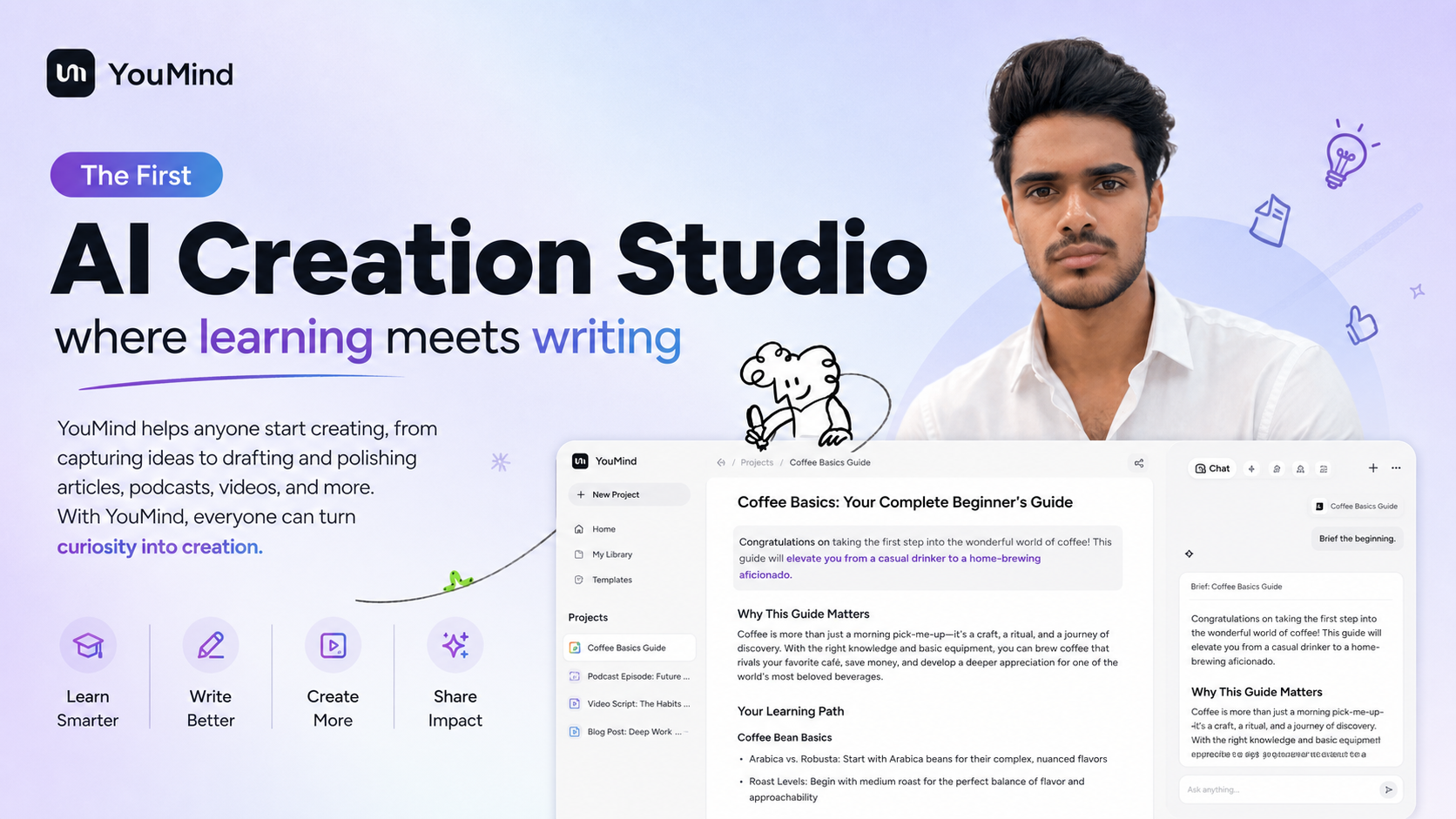
YouMind is built around that gap. It describes itself as an AI creation studio where learning meets writing. The platform is designed to help people start creating from the earliest stage of curiosity and move toward finished formats such as articles, podcasts, videos, and other content.
The website is available at https://youmind.com.
What Is YouMind?
YouMind is an AI-based creation platform focused on helping users turn ideas and learning materials into content. Instead of treating writing as a separate activity that begins with a blank page, it connects the process of learning, capturing ideas, drafting, and polishing.
This makes the platform relevant for people who regularly consume information and want to do something with it. That could include writing an article, preparing a podcast outline, developing a video script, or organizing thoughts around a topic.
The central idea is simple: curiosity can become creation when there is a smoother path from thinking and learning to producing something structured.
The Main Purpose Behind YouMind
Many people collect notes, bookmarks, screenshots, references, and rough thoughts across different tools. Over time, those ideas can become scattered. When it is time to create, the first task is often not writing, but sorting through everything and deciding what matters.
YouMind appears to address this by providing a workspace where the creative process can begin with capturing ideas and continue through drafting and refinement. This is especially useful for people who do not see content creation as a single step, but as a sequence of small actions.
The platform’s focus is not only on generating text. It is about supporting a broader creation flow, including:
- Capturing early ideas before they are fully formed
- Organizing thoughts around topics or themes
- Moving from learning to structured output
- Drafting content for different formats
- Polishing work before publishing or sharing
Who Might Use YouMind?
YouMind can be relevant to different kinds of users because the act of turning information into something useful is common across many fields. It may be used by individuals who create content publicly, but also by people who need to organize ideas for work, study, or personal projects.
Possible use cases include:
- Writers who want help shaping ideas into article drafts
- Students and learners who want to transform what they study into clearer notes or summaries
- Professionals who need to prepare briefs, outlines, scripts, or internal content
- Podcasters who want to organize themes before recording
- Video creators who need to turn research and ideas into scripts or talking points
- Independent thinkers who collect ideas and want a structured way to develop them
The platform is not limited to one type of creator. Its broader positioning suggests that it is meant for anyone who wants to move from curiosity to a more finished form of expression.
How YouMind Fits Into the Creation Process
Content creation is often described as writing, recording, or publishing. In practice, there are several steps before and after that moment. YouMind is designed to support more of the full journey.
1. Capturing Ideas
The first stage is collecting thoughts while they are fresh. Ideas are often incomplete at this point. They may be questions, observations, rough notes, or topics worth exploring later. A creation studio that allows this early capture can help reduce the pressure to make everything polished immediately.
2. Learning and Exploring
YouMind’s tagline connects learning with writing. This matters because many pieces of content are based on exploration. Before someone writes about a topic, they usually need to understand it, compare ideas, and decide what angle to take.
By placing learning close to the creation process, the platform supports a workflow where research and writing are not separated too far from each other.
3. Drafting Content
Once ideas are organized, the next step is often a draft. A draft does not need to be perfect. It gives structure to the material and makes it easier to see what is missing, what needs more detail, and what should be removed.
YouMind is designed to help with drafting content such as articles, podcast materials, videos, and more. This suggests flexibility across formats rather than a narrow focus on traditional long-form writing.
4. Polishing the Output
Polishing is where content becomes clearer and easier to understand. This can include improving flow, adjusting tone, simplifying sentences, or making the structure more readable. For many creators, this stage takes as much effort as the first draft.
An AI-supported polishing process can help users review and refine their work before it is shared elsewhere.
Why the “Learning Meets Writing” Approach Matters
The phrase “learning meets writing” reflects a common reality: people often learn more deeply when they try to explain something. Writing, scripting, or outlining forces ideas to become clearer. It also reveals gaps in understanding.
YouMind’s approach recognizes that creation is not only about producing content for an audience. It can also be a way to think. When people turn curiosity into an article, podcast outline, or video script, they are also organizing their own understanding.
This can be useful in professional settings as well. A person researching a new topic for work may need to turn what they learn into a report, presentation, or internal explanation. A student may need to turn study material into notes or essays. A creator may need to turn scattered research into a publishable piece.
Types of Content YouMind Supports
The platform describes support for articles, podcasts, videos, and more. These formats have different requirements, but they all start with ideas and structure.
- Articles: Useful for developing a topic in a clear written format with sections and arguments.
- Podcasts: Often require outlines, episode themes, questions, and talking points before recording.
- Videos: Usually need scripts, scene ideas, explanations, or narration structure.
- Other formats: The same process can apply to notes, summaries, briefs, and concept drafts.
This flexibility is important because many people create in more than one format. A single idea might become a blog post, then a podcast discussion, and later a video script. A workspace that supports different outputs can help keep the original thinking connected.
A Practical Way to Think About YouMind
YouMind can be understood as a bridge between information intake and content output. It is not only about writing faster. It is about giving shape to the process that happens before writing and after the first draft.
For someone who often has ideas but struggles to begin, the platform’s structure may help make the starting point clearer. For someone who already creates regularly, it may serve as a place to develop and refine material across formats.
As with any AI tool, the quality of the final result depends on how it is used. Human judgment remains important for accuracy, clarity, originality, and context. AI can assist with organization, drafting, and refinement, but the creator still decides what the work should say and why it matters.
Final Thoughts
YouMind is an AI creation studio built around the connection between curiosity, learning, and writing. Its focus is on helping people capture ideas, develop drafts, and polish content for formats such as articles, podcasts, and videos.
For anyone exploring tools that support the creative process from early thinking to finished output, YouMind is one platform worth knowing about. More information is available on its website: https://youmind.com.