Loki.Build: An AI-Native Website Builder for Creating Landing Pages Faster
Creating a landing page is often one of the first steps when launching a product, testing an idea, collecting leads, or presenting a service online. The challenge is that the process can quickly become slower than expected. Some people hire agencies, some work with designers and developers, and others use website builders that rely heavily on templates. Each option has its place, but each can also add time, cost, or limitations.
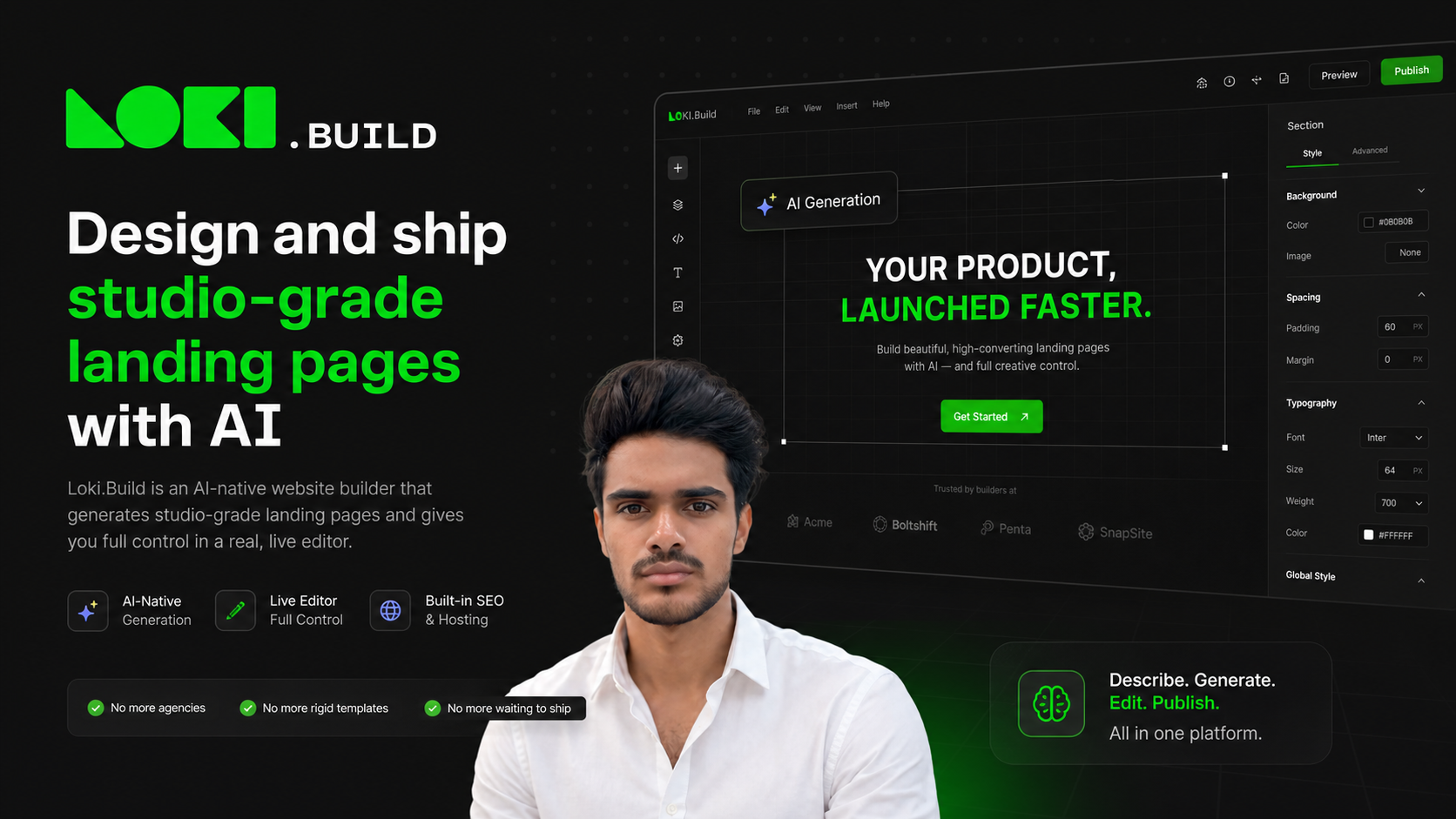
Loki.Build is a platform designed around a more direct approach. It is an AI-native website builder that helps users generate landing pages and then refine them inside a real live editor. The platform focuses on landing pages rather than trying to be a general-purpose website system for every possible use case.
The official website is available at https://loki.build.
What Is Loki.Build?
Loki.Build is an AI-powered website builder built for creating landing pages. Its main idea is to help users move from an initial concept to a designed page without starting from a blank screen or relying entirely on rigid templates.
The platform describes itself as an AI-native builder for creating studio-grade landing pages. In practical terms, this means the tool uses AI to generate the structure and design direction of a landing page, while still giving users the ability to edit and control the final result.
Instead of only providing pre-made layouts, Loki.Build aims to combine generation with manual editing. This is useful because landing pages often need specific copy, sections, styling, and calls to action based on the product, audience, or campaign.
The Problem It Is Trying to Solve
Landing pages can be simple in concept, but they often involve several small decisions. A page may need a clear headline, product description, feature sections, visuals, trust elements, frequently asked questions, pricing information, and a strong call to action. Even a short page can require design and content choices that slow down the publishing process.
Traditional approaches usually fall into a few categories:
- Hiring an agency or freelancer: This can produce custom work, but it may take time and involve back-and-forth communication.
- Using a template-based builder: This can be faster, but templates may feel restrictive if the page needs a specific layout or style.
- Building manually with code: This gives control, but it requires technical knowledge and development time.
- Using separate tools for design, content, hosting, and SEO: This can create extra setup work before the page is even published.
Loki.Build positions itself as a way to reduce some of this friction by bringing AI generation, editing, SEO, and hosting into one workflow.
AI Generation With a Live Editor
One of the key parts of Loki.Build is its combination of AI-generated pages and a live editor. AI can help produce an initial landing page direction, but generated results usually need refinement. A live editor matters because it allows users to adjust the page directly instead of treating the AI output as a final, fixed result.
This approach gives the workflow two layers. First, the AI helps create a starting point. Then, the editor allows users to make changes and shape the final page. This can include adjusting content, modifying sections, changing layout details, or improving how the page communicates the product or service.
The platform’s emphasis on control is important. Many AI tools generate outputs quickly, but not all of them provide enough editing flexibility afterward. Loki.Build is presented as a tool where the generated page is not the end of the process. It is something that can be edited in a real environment before publishing.
Built-In SEO Features
Search visibility is another part of the landing page process. Even if a landing page is mainly used for ads, social links, product launches, or direct traffic, basic SEO settings are still useful. Loki.Build includes built-in SEO features, which means users do not have to treat SEO setup as a completely separate step.
For a landing page, SEO-related work may include page titles, descriptions, content structure, headings, and other elements that help the page be understandable to search engines and visitors. Built-in SEO tools can make this easier for people who want to publish a page without manually configuring everything through separate plugins or external systems.
The platform does not need to replace a full SEO strategy, but having SEO included in the builder can help with the fundamentals of publishing a clean and understandable page.
Hosting Included
Loki.Build also includes hosting. This is a practical detail because many website creation workflows require a separate hosting setup. A user may design a page in one tool, export it, connect it to hosting, configure domains, and then manage publishing separately.
When hosting is included in the platform, the path from creation to publishing can be shorter. Users can focus on building and editing the page without needing to immediately handle a separate technical hosting stack.
For landing pages, this is especially relevant because speed matters. A campaign, launch, waitlist, or product test often needs a page online quickly. Including hosting helps reduce the number of steps between the page being created and the page being live.
Who Might Use Loki.Build?
Loki.Build is mainly relevant to people or teams that need landing pages and want a faster way to create them while keeping editing control. It can fit several use cases, depending on the project.
- Startup founders who need a landing page for a product idea, waitlist, or early launch.
- Solo creators who want to present a service, digital product, newsletter, or community.
- Marketing teams that need campaign pages without waiting on a long design and development cycle.
- Agencies or consultants who create landing pages for client projects and need a faster starting point.
- Product teams testing messaging, positioning, or new feature interest.
The platform is especially aligned with situations where the goal is not to build a large, complex website, but to publish a focused landing page with clear messaging and a polished structure.
How It Differs From Rigid Templates
Template-based website builders are common because they make it easy to start quickly. The limitation is that templates often come with fixed assumptions. A user may need to fit their content into an existing layout instead of shaping the page around their message.
Loki.Build’s AI-native approach is different because the starting point is generated rather than selected from a static template. The page can then be adjusted in the live editor. This does not remove the need for decision-making, but it can make the first draft of the page easier to produce.
This distinction matters for landing pages because every offer or product can require a different structure. A software tool, consulting service, event page, and newsletter signup page may all need different section priorities. A more flexible builder can help users adapt the page to the message rather than adapting the message to the template.
Important Things to Keep in Mind
Like any AI-assisted tool, Loki.Build should be understood as part of the page creation process, not a replacement for clear thinking. A landing page still needs accurate information, a clear audience, useful copy, and a specific goal. AI can help generate and structure the page, but the user still needs to review the result carefully.
Before publishing any landing page, it is useful to check:
- Whether the headline clearly explains the offer.
- Whether the page has one main goal or call to action.
- Whether all product or service claims are accurate.
- Whether the page works well on different screen sizes.
- Whether SEO titles, descriptions, and headings are clear.
- Whether the contact, signup, or conversion flow works correctly.
These checks are important regardless of which builder is used. A well-designed page still depends on the quality and accuracy of the information on it.
Final Overview
Loki.Build is an AI-native website builder focused on helping users design and ship landing pages. It brings together AI generation, a live editor, built-in SEO, hosting, and editing control in one platform.
Its main purpose is to reduce the friction involved in creating landing pages, especially for people who do not want to start from scratch, wait on a long production process, or work within rigid templates. The platform is centered on moving quickly while still allowing users to refine the final page before publishing.
For anyone exploring tools for building landing pages, Loki.Build is one of the newer AI-focused platforms to be aware of. More details are available on its website: https://loki.build.