Heard: A Voice Layer for Claude Code, Codex, and Cursor Workflows
AI coding agents are becoming part of many development workflows, but they can also create a new kind of attention problem. When an agent is working in a terminal or editor, there is often a stream of output to monitor: progress updates, errors, questions, decisions, and summaries. If several agents are running at once, keeping track of what is happening can become difficult, especially when the work is spread across multiple windows.
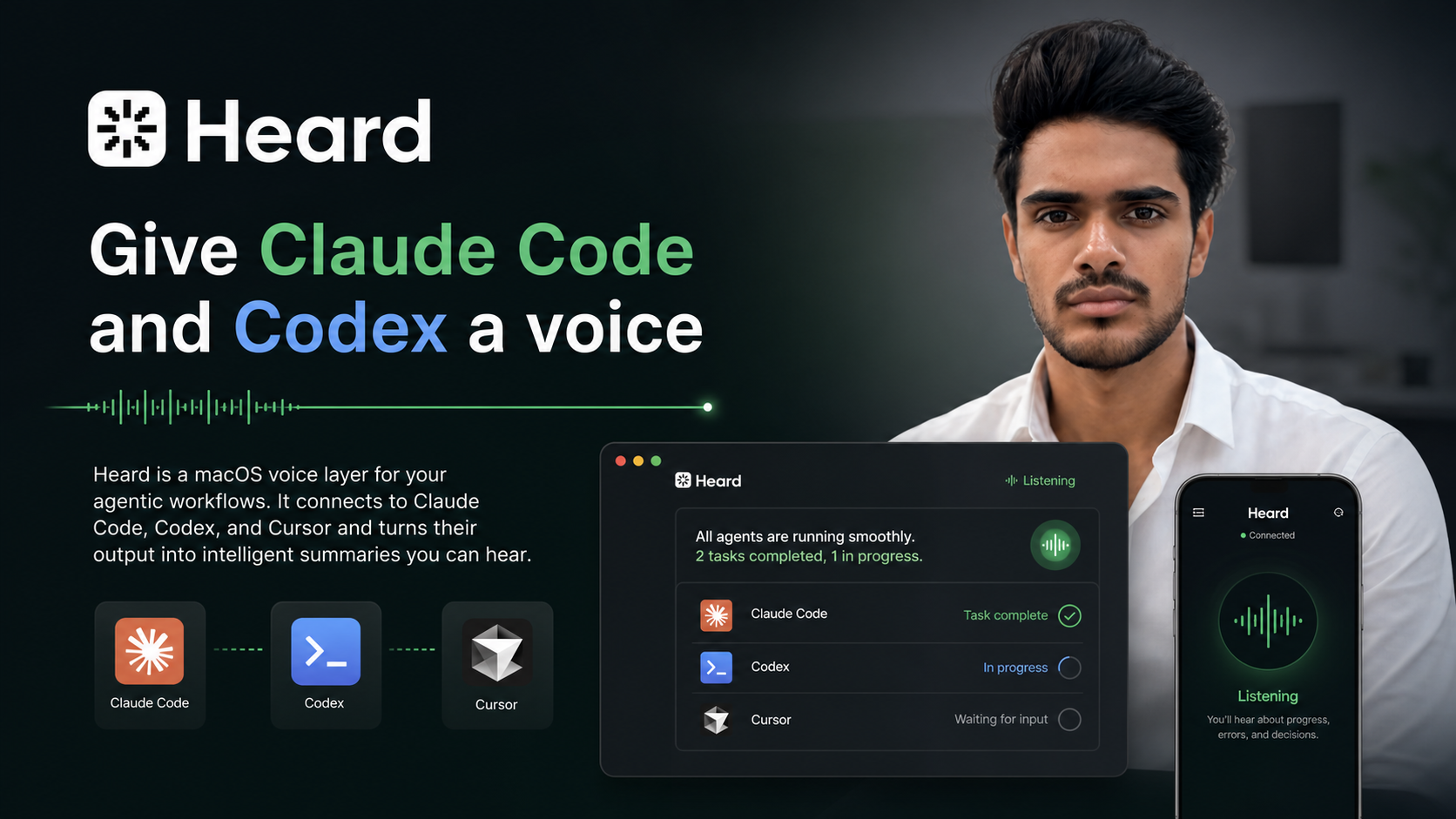
Heard is a macOS voice layer built for this kind of workflow. It connects to tools such as Claude Code, Codex, and Cursor, then turns their output into intelligent audio summaries. The idea is simple: instead of reading every line of agent output, users can listen to a summary of what is happening.
The platform is available at https://heard.dev.
What Heard Is
Heard is not another coding agent. It does not replace Claude Code, Codex, or Cursor. Instead, it sits alongside them and gives their activity a voice. It is designed for macOS and focuses on agentic workflows where coding tools perform tasks, report progress, encounter issues, or ask for user decisions.
In practical terms, Heard turns agent output into spoken commentary. That commentary can be continuous when the user wants to stay informed, or quieter when the user only wants to be interrupted for important events.
This makes Heard less about generating code and more about managing attention while agents are running.
The Main Problem It Addresses
Agentic coding workflows can be useful, but they often require supervision. Even when the agent is doing the work, someone still has to notice whether it is progressing, stuck, waiting for input, or encountering an error.
That supervision usually happens visually. A user may keep an eye on terminal output, switch between editor panes, or check several running tasks. This can be distracting if the person is also reading documentation, reviewing code, writing notes, joining a call, or stepping away from the desk.
Heard approaches this problem through audio. Instead of requiring constant visual attention, it provides voice updates that summarize what the agents are doing. The goal is to help users stay aware of progress without needing to watch every output stream.
How Heard Works at a High Level
Heard connects with Claude Code, Codex, and Cursor. Once connected, it listens to agent activity and produces spoken summaries based on what is happening. The emphasis is on summaries rather than simply reading raw output aloud.
This distinction matters because raw terminal output can be noisy. Agents may print logs, intermediate steps, repeated status messages, or large blocks of technical text. Heard is described as turning output into intelligent summaries, which means the audio is intended to communicate the useful state of the work rather than narrating everything line by line.
The platform supports different listening styles, depending on how much audio feedback a user wants.
Listening Modes: Commentary or Quiet Monitoring
One useful aspect of Heard is that it is not limited to constant narration. Different workflows need different levels of interruption.
For example, there may be times when a user wants full commentary. This could be helpful when their eyes are elsewhere but they still want to understand the flow of work. In that mode, Heard can provide more frequent spoken updates as the agent progresses.
There may also be times when constant audio would be unnecessary. Heard can remain quiet until something important happens, such as an error or a decision that requires input. This makes it more like a monitoring layer for agent workflows, where the user is only pulled back in when attention is needed.
Based on the description, Heard supports both patterns:
- Full commentary for situations where ongoing spoken feedback is useful.
- Quiet monitoring for situations where audio should only appear when something needs attention.
- Error awareness so users can know when a workflow runs into a problem.
- Decision prompts when an agent needs the user to choose what should happen next.
Designed for Parallel Agent Workflows
Many developers are beginning to run more than one coding agent at a time. One agent might be working on tests, another on a refactor, and another on a separate feature branch. This can increase throughput, but it also increases the amount of output to monitor.
If every running agent simply spoke all of its output at once, the result would not be helpful. Heard addresses this by summarizing at the project level when agents are running in parallel. Instead of creating a situation where multiple terminals are competing for attention, Heard aims to provide a clearer summary of where the overall work stands.
This project-level approach is important because the user usually does not need to hear every detail from every agent. Often, the more useful question is: what is done, what is blocked, what needs review, and what requires a decision?
Pairing With a Phone
Heard also includes phone pairing. This means the audio layer can come with the user beyond the Mac itself. The product description does not frame this as a separate mobile productivity system, but as an extension of the same voice-based workflow.
This can matter in everyday situations where an agent is running but the user is not sitting directly in front of the screen. If a workflow needs attention, phone pairing gives Heard a way to keep the user informed while they are away from the desk.
Who Might Find Heard Relevant
Heard is specifically focused on people using agentic development tools on macOS. It is most relevant in workflows where coding agents produce enough output that monitoring becomes a task of its own.
Examples of users or situations where Heard may be relevant include:
- Developers using Claude Code, Codex, or Cursor as part of coding work.
- People who run long agent tasks and do not want to watch the terminal continuously.
- Users who manage multiple agent sessions at the same time.
- Developers who want to be alerted when a task errors or needs a decision.
- People who prefer audio summaries while reading, writing, reviewing, or stepping away from the desk.
It is less relevant for someone who does not use these agentic coding tools, does not work on macOS, or prefers to inspect all output manually.
Open Source and Free for Personal Use
Heard is described as open source and free for personal use. That is an important detail for individuals who want to explore the tool without treating it as a paid commitment. Open source availability can also matter to developers who prefer software that can be inspected or understood more directly.
The description does not specify every licensing or commercial-use detail, so anyone planning to use it in a company or team setting should check the website for the latest information. For personal use, the platform is presented as free.
How Heard Fits Into a Development Workflow
Heard fits into a workflow as an awareness layer. The coding agent still performs the task. The editor or terminal still remains the place where work is executed and reviewed. Heard adds spoken context on top of that.
A typical flow might look like this:
- Start an agent task in Claude Code, Codex, or Cursor.
- Let Heard monitor the output from the running workflow.
- Listen to spoken summaries while working on something else.
- Return to the task when Heard reports an error, decision point, or meaningful status update.
- Review the actual code, changes, and output in the original development tool.
This keeps the final responsibility where it already belongs: with the user reviewing the work. Heard does not remove the need to inspect code or understand what the agent changed. It simply changes how progress information can be consumed while the work is happening.
Things to Keep in Mind
Based on the available description, Heard is focused on a specific environment and use case. It is a macOS tool for people using Claude Code, Codex, and Cursor. It is not described as a general-purpose screen reader, meeting assistant, or notification system.
It is also important to understand that summaries are still summaries. They are useful for awareness, but they are not a substitute for reviewing actual outputs, code changes, errors, and decisions inside the development environment.
Final Overview
Heard is a macOS voice layer for agentic coding workflows. It connects with Claude Code, Codex, and Cursor, then turns their output into spoken summaries. It can provide full commentary, stay quiet until something needs attention, summarize parallel agents at the project level, and pair with a phone so updates can follow the user away from the desk.
For people already working with coding agents, Heard addresses a practical issue: staying informed without constantly watching terminals or editor output. More details are available on the official website: https://heard.dev.