ZooData: A Structured Data Layer for AI Agents Working With Web Pages
AI agents are becoming more useful in everyday workflows, but one challenge keeps coming up: the web is not always easy for agents to read. Most websites are built for people, not automated systems. Pages often contain raw HTML, navigation menus, scripts, ads, styling code, and other elements that make it harder for an AI agent to identify the exact information it needs.
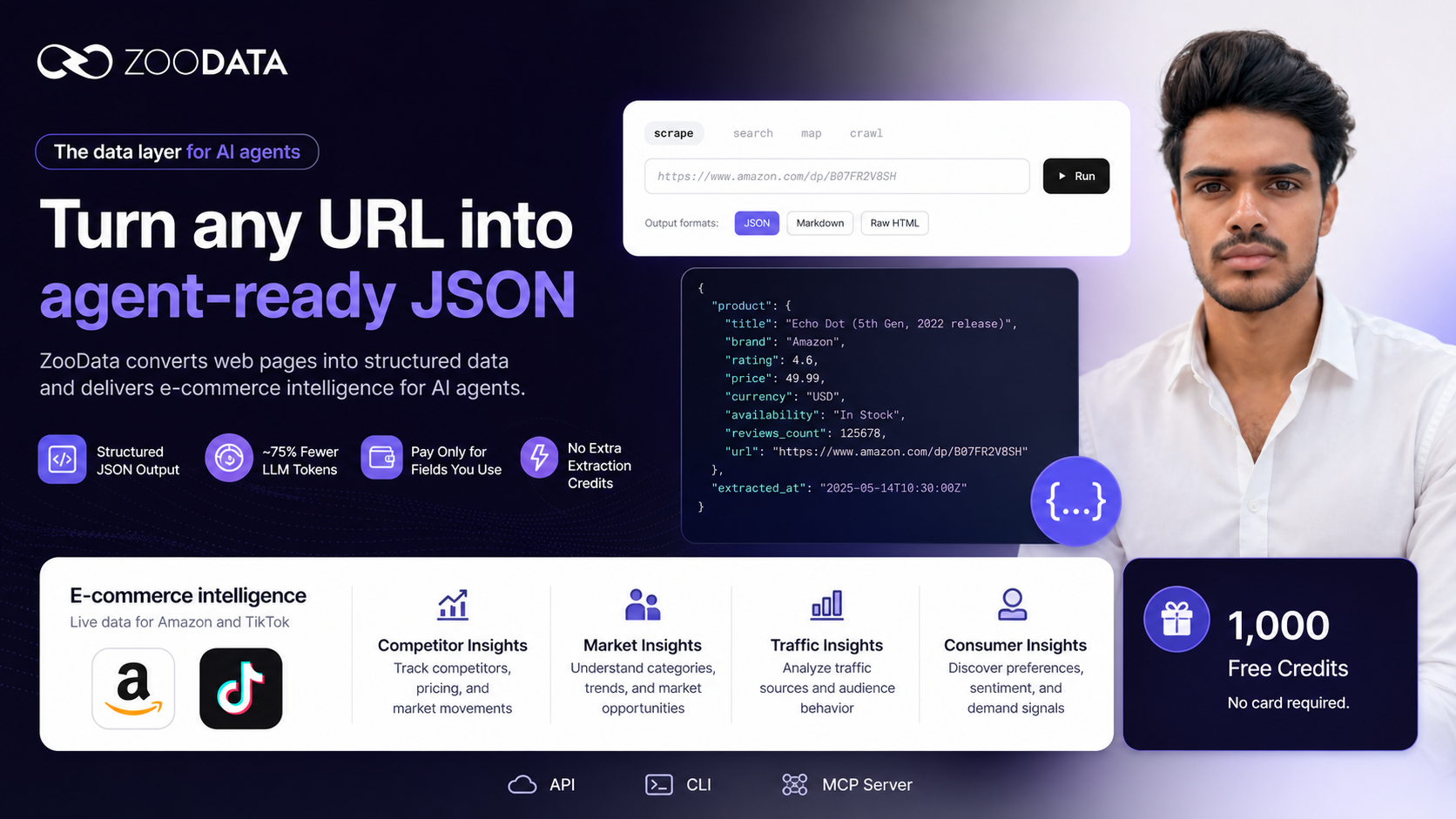
ZooData is a platform designed to address this problem by turning any URL into structured, agent-ready JSON. Instead of asking an AI agent or language model to process an entire webpage as raw HTML or long markdown, ZooData provides a cleaner data layer that agents can use more directly.
The platform is available at https://zoodata.ai.
What ZooData Does
ZooData focuses on converting web pages into structured data. In practical terms, this means a user can provide a URL, and ZooData returns JSON that is easier for AI agents, applications, and automation tools to work with.
This is different from simply scraping a page and passing all of the content to a language model. A raw webpage may include a large amount of unnecessary information. Even markdown conversions can still be bulky, especially when the goal is to extract only a few specific fields from a page.
ZooData is built around the idea that AI agents should not have to read everything on a page if they only need certain structured details. By returning agent-ready JSON, the platform helps reduce the amount of text that needs to be processed by an LLM.
Why Structured Data Matters for AI Agents
AI agents often need to perform tasks that involve reading information from websites. These tasks may include checking product details, comparing prices, collecting market data, tracking competitors, or feeding external information into a workflow.
When the input is unstructured, the agent has to spend more effort interpreting the content. This can increase token usage, slow down workflows, and make extraction less predictable. Structured JSON gives the agent a clearer format to work with.
For example, instead of processing a long page and trying to determine where the product title, price, rating, or description appears, an agent can work with a structured response where those fields are already separated.
Key Features of ZooData
ZooData combines web data extraction with tools aimed at agent-based workflows. Its main features include:
- URL-to-JSON conversion: ZooData turns web pages into structured JSON that AI agents can use more easily than raw HTML.
- Lower token usage: The platform states that users can use around 75% fewer LLM tokens by working with structured data instead of larger page formats.
- Field-based usage: ZooData is designed so users pay only for the fields they use.
- No extra extraction credits: The platform notes that users can skip additional extraction credits.
- E-commerce intelligence: ZooData also provides pre-analyzed insights for e-commerce use cases, including competitor, market, traffic, and consumer insights.
- Amazon and TikTok support: Its e-commerce intelligence features are live for Amazon and TikTok.
- Multiple ways to connect: ZooData includes an API, CLI, and MCP server.
- Free starting credits: New users can start with 1,000 free credits, with no card required.
How It Fits Into AI Agent Workflows
ZooData is especially relevant in workflows where an AI agent needs to access web-based information repeatedly or at scale. Instead of manually copying page content or building custom scraping scripts, the platform provides a structured data layer that can be connected through an API, command-line tool, or MCP server.
The inclusion of an MCP server is notable because MCP is commonly used to connect AI tools with external systems and data sources. With this setup, an AI agent can potentially access structured web data through a more standardized interface, rather than relying only on browser-based reading or prompt-based extraction.
The CLI may be useful for developers or technical users who want to test queries, automate tasks, or integrate ZooData into scripts. The API is likely the main connection point for applications and production workflows.
E-Commerce Intelligence Beyond Basic Extraction
ZooData is not limited to extracting fields from webpages. It also includes pre-analyzed e-commerce intelligence for Amazon and TikTok. This means the platform is intended to provide more than raw product or page data.
The available intelligence areas include:
- Competitor insights: Information that can help compare products, brands, or sellers within a market.
- Market insights: Data that can support broader understanding of categories, demand, or positioning.
- Traffic insights: Information related to how attention or visits may be distributed.
- Consumer insights: Data that may help understand customer behavior, preferences, or product interest.
For teams working with online retail, marketplace research, social commerce, or product monitoring, these kinds of structured insights can be used as inputs for analysis, dashboards, internal tools, or agent-driven reports.
Potential Use Cases
ZooData can be understood as infrastructure for people building or using AI agents that rely on web data. Some possible use cases include:
- Product data extraction: Pulling structured details from product pages so an agent can compare or summarize them.
- Competitor monitoring: Tracking changes in product listings, pricing, positioning, or marketplace activity.
- Market research: Gathering structured information from multiple URLs to support research workflows.
- Agent automation: Giving AI agents a cleaner data input so they can complete tasks with less prompt complexity.
- Internal data tools: Feeding structured web data into dashboards, reports, or business applications.
- LLM cost management: Reducing unnecessary token usage by sending only relevant structured fields to a model.
Why Token Reduction Can Be Important
Token usage matters in many AI workflows because language models typically charge based on the amount of text processed. If an agent sends an entire webpage to a model, it may include thousands of tokens that are not directly relevant to the task.
By working with structured JSON, an application can send a smaller and more focused payload to the model. ZooData states that this approach can reduce LLM token usage by about 75%. The exact savings would depend on the page, the fields requested, and how the workflow is designed.
This can also make agent behavior easier to manage. When data is returned in predictable fields, prompts can be simpler. The model does not need to infer as much from a messy page structure.
Who Might Find ZooData Relevant
ZooData may be relevant for developers, AI builders, automation teams, e-commerce analysts, and businesses that need structured web data for agent workflows. It is particularly aligned with use cases where agents interact with URLs and need clean data outputs instead of large unstructured page content.
It may also be useful for people experimenting with AI agents and MCP-based workflows, especially if their projects involve web research, product intelligence, or marketplace data.
Getting Started
ZooData offers 1,000 free credits to start, and no card is required. This gives users a way to explore the platform and see how its URL-to-JSON conversion and e-commerce intelligence features fit into their workflows.
The platform can be accessed through its website: https://zoodata.ai.
Final Thoughts
ZooData addresses a practical issue in AI agent development: web pages are often too messy and token-heavy for efficient automated use. By turning URLs into structured JSON, it gives agents a cleaner data layer to work with.
Its additional focus on Amazon and TikTok e-commerce intelligence makes it more specific than a general extraction tool. With API, CLI, and MCP server access, ZooData is positioned for technical workflows where structured web data needs to move directly into agents, applications, or analysis systems.