Dograh: An Open Source Platform for Building Voice Agents
Voice agents are becoming part of many everyday workflows, from answering customer calls to routing support requests and collecting information before a human takes over. As more teams experiment with voice automation, one common challenge is deciding where the agent should live, how much control the team should have, and whether the platform should be fully hosted or self-managed.
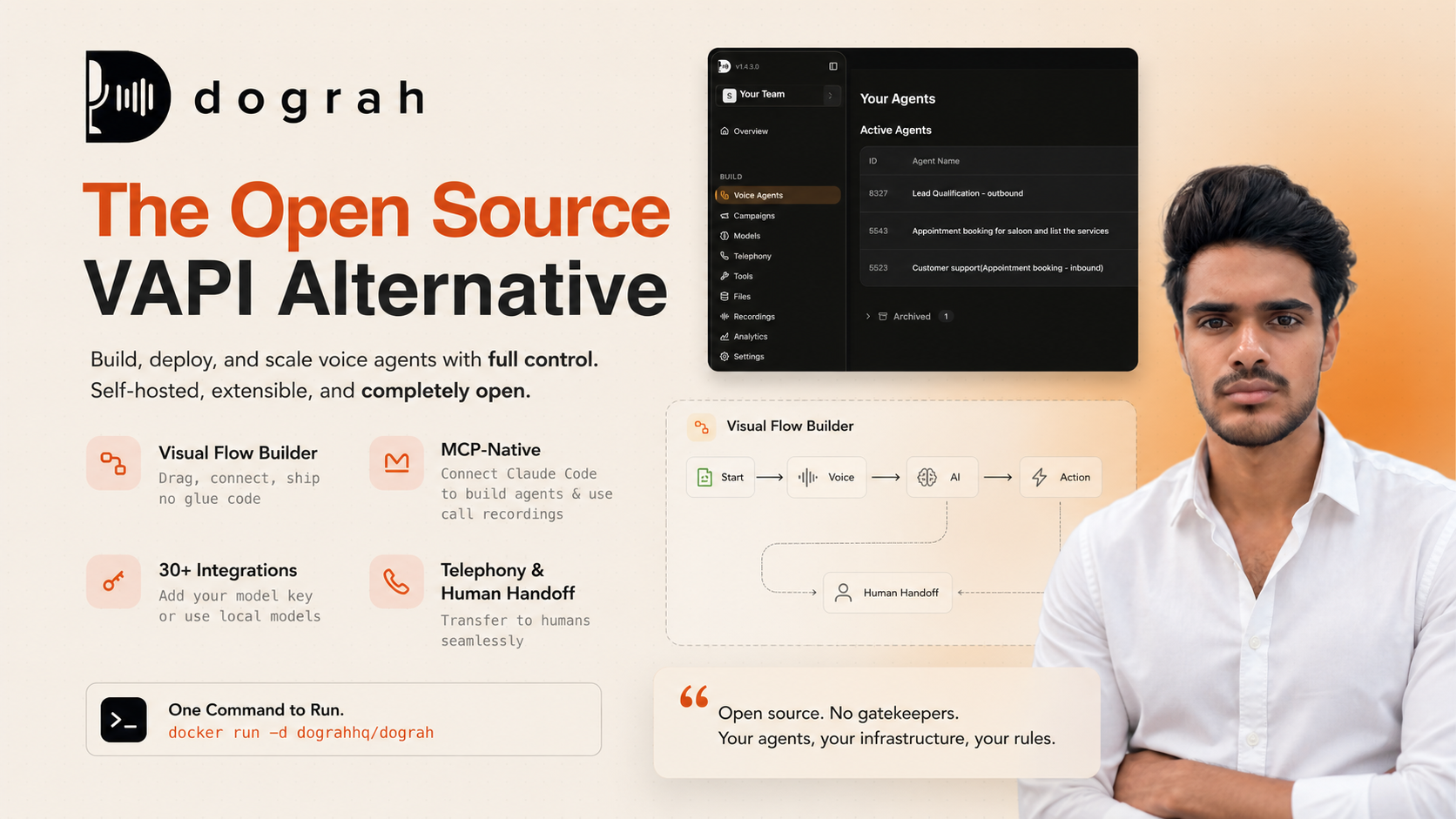
Dograh is a platform built around a clear idea: voice agents should not be locked behind a closed system. It describes itself as the open source VAPI alternative, and its focus is on giving developers and teams the ability to build, run, and monitor voice agents without depending entirely on a gated voice platform.
The website is available at https://dograh.com.
What Is Dograh?
Dograh is an open source platform for creating voice agents. It includes tools for designing call flows, connecting language models, handling telephony, transferring calls to humans, and reviewing agent performance through quality assurance and monitoring features.
The platform is positioned for people who want more control over their voice agent setup. Instead of renting agents through a closed voice platform, Dograh allows users to self-host the system and bring their own model keys across a wide range of integrations. It also supports local models, which can be useful in environments where teams want to run models closer to their own infrastructure.
A major part of Dograh’s identity is that it is completely open source. According to the platform description, nothing is gated, and the available features are free to self-host. This makes it especially relevant for developers, technical teams, startups, and organizations that prefer transparent infrastructure over closed, fully managed tools.
Why Open Source Matters for Voice Agents
Voice agents often touch sensitive workflows. They may handle customer questions, appointment details, lead information, internal requests, or support conversations. Because of that, many teams care about visibility, control, and the ability to adapt the system to their own needs.
Closed voice platforms can be convenient, but they may also limit how much a team can customize. Pricing, hosting, available integrations, data handling, and advanced controls can all depend on the platform’s rules. An open source approach gives teams another option.
With an open source voice platform like Dograh, users can inspect the system, self-host it, and adapt it for specific use cases. This does not remove the need for technical knowledge, but it can provide more flexibility for people who want to understand and control the voice agent stack.
Main Features of Dograh
Dograh brings together several pieces that are usually needed to build practical voice agents. Instead of focusing only on a chatbot-like experience, it includes the surrounding tools required for real call workflows.
Visual Flow Builder
Dograh includes a visual flow builder for creating voice agent logic. A flow builder can make it easier to map what should happen during a call, such as greeting a caller, asking questions, checking a condition, routing the conversation, or handing off to another step.
This type of interface can be useful when designing agents that need to follow structured paths. It can also help teams review how a call is expected to move from one stage to another.
Model Integrations
Dograh allows users to add their own model key across more than 30 integrations. This means the platform is not tied to a single AI model provider. Teams can connect the model provider that fits their needs, depending on their preferences for cost, performance, availability, or internal standards.
The platform also supports local models. This can be relevant for users who want to experiment with running models in their own environment or who have specific infrastructure requirements.
Telephony Support
For voice agents to be useful in real scenarios, they need to connect with phone systems. Dograh includes telephony support, which allows voice agents to work in call-based environments rather than remaining limited to a demo or text-based interface.
Telephony is an important part of voice automation because it connects the agent to the channels people already use. Whether the goal is inbound call handling, outbound workflows, or structured call routing, telephony support is a core requirement.
Human Transfer
Not every call should be handled entirely by an AI agent. Some conversations require a person, especially when the caller has a complex issue, asks for something outside the agent’s scope, or needs reassurance from a human representative.
Dograh includes human transfer, which allows a call to move from the voice agent to a person. This helps make voice automation more practical because it supports hybrid workflows where the agent handles routine steps and humans take over when needed.
Quality Assurance and Monitoring
Dograh also includes advanced QA and monitoring features. For voice agents, monitoring is important because real conversations can be unpredictable. Teams need ways to understand how calls are going, where agents are failing, and whether the flow needs improvement.
QA and monitoring can help teams review call behavior, identify issues, and improve the agent over time. This is especially important for professional use cases where accuracy, reliability, and escalation matter.
Self-Hosting in One Command
One of the notable details about Dograh is that it can be self-hosted in one command. Self-hosting can appeal to developers and technical teams that want to run the platform on their own infrastructure instead of relying entirely on a hosted service.
Self-hosting may be useful for several reasons:
- Control: Teams can manage the environment where the platform runs.
- Transparency: The open source code can be reviewed and understood.
- Flexibility: The setup can be adapted to specific workflows or infrastructure needs.
- Model choice: Users can connect supported providers or use local models.
- Cost structure: Since the platform is free to self-host, teams can evaluate infrastructure and model costs separately.
Self-hosting is not the same as using a fully managed platform. It usually requires comfort with deployment, configuration, maintenance, and security. For technical users, however, it can provide a different level of control over how voice agents are built and operated.
Connecting Claude Code with MCP
Dograh also mentions the ability to connect Claude Code with MCP to build voice agents for a use case or call recordings. MCP, commonly known as the Model Context Protocol, is used to connect AI tools with external systems and context.
In practical terms, this can support workflows where a developer uses Claude Code alongside Dograh to create or improve voice agents. It may also help when working with call recordings, where the goal is to analyze previous conversations or build agents based on real interaction patterns.
This feature points toward a more developer-friendly workflow, where voice agent building is not only done through a dashboard but can also connect with coding tools and AI-assisted development environments.
Who Might Find Dograh Useful?
Dograh is most relevant for people or teams exploring voice agents with a preference for open source tools and self-hosted systems. It may fit different professional contexts, especially where voice communication is already part of the workflow.
Potential use cases include:
- Customer support call routing and first-response handling
- Appointment scheduling or intake conversations
- Lead qualification over the phone
- Internal helpdesk or operations workflows
- Call recording analysis and agent improvement
- Prototype voice agents for specific business processes
The platform can also be useful for developers who want to experiment with voice AI without being limited to a closed system. Since it supports multiple model integrations and local models, it leaves room for testing different technical approaches.
Things to Keep in Mind
Dograh’s open source and self-hosted approach gives users control, but it also means users should be prepared for the responsibilities that come with running software themselves. Deployment, updates, infrastructure, model keys, telephony setup, security, and monitoring all need attention.
For non-technical users, a self-hosted voice agent platform may require help from a developer or technical team. For technical users, the tradeoff is more direct control over the system and the ability to adapt it to specific needs.
Final Overview
Dograh is an open source platform for building and running voice agents. It combines a visual flow builder, support for more than 30 model integrations, local model options, telephony, human transfer, and QA and monitoring tools. It is designed as an alternative to closed voice platforms, with a focus on self-hosting and transparency.
For anyone researching the voice agent space, Dograh is worth knowing about because it represents a different approach: one where the platform is open, the models are flexible, and the voice agent infrastructure can be run by the user. More information is available at https://dograh.com.