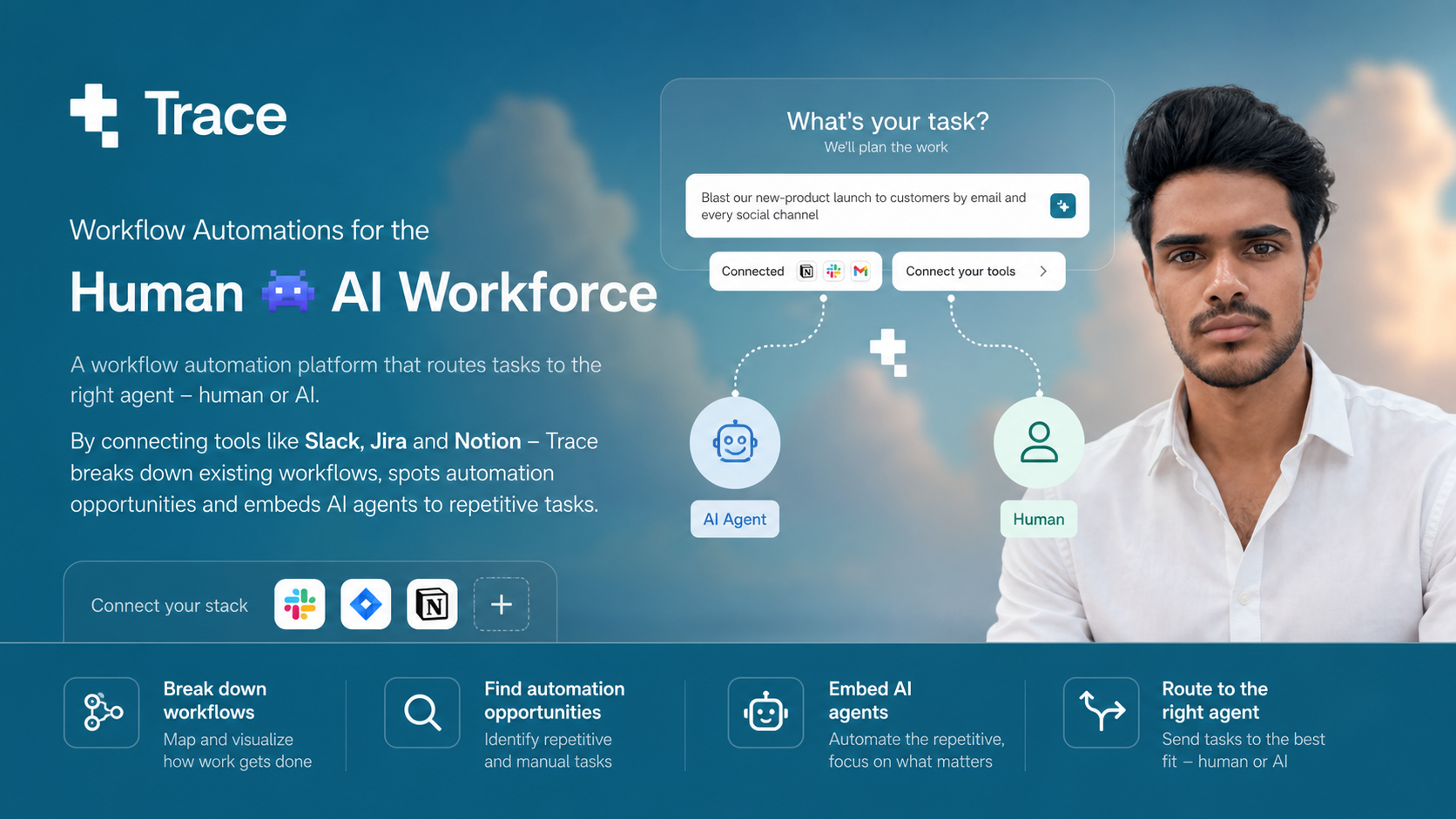
Trace: A Practical Look at Workflow Automation for Human and AI Teams
Many teams now work across a mix of chat apps, project management tools, documentation platforms, spreadsheets, dashboards, and internal systems. A task may start in Slack, turn into a ticket in Jira, get documented in Notion, and then require follow-up across several people or tools. This can make everyday work harder to track, especially when repetitive steps are spread across different platforms.
Trace is a workflow automation platform built around this type of environment. Its focus is on routing tasks to the right agent, whether that agent is a human or an AI system. The platform is designed for teams that already have workflows in place and want to understand where automation can help without fully removing people from the process.
The platform is available at https://www.trace.so.
What Is Trace?
Trace is described as a workflow automation platform for the human and AI workforce. In simple terms, it helps connect the tools a team already uses, looks at how work moves between those tools, and identifies places where AI agents can take over repetitive tasks.
Instead of treating automation as a separate layer that sits outside daily work, Trace is centered on existing workflows. That means the platform is not only about creating isolated automations, but also about understanding how tasks currently happen across communication, project tracking, and knowledge management tools.
Trace mentions integrations with tools such as Slack, Jira, and Notion. These are common parts of modern team operations:
- Slack is often where requests, updates, and approvals begin.
- Jira is commonly used to manage engineering, product, or operational tasks.
- Notion is frequently used for documentation, planning, and shared team knowledge.
By connecting tools like these, Trace aims to break down workflows and identify where human effort is being spent on repeated actions that may be suitable for AI assistance.
The Main Idea: Routing Work to the Right Agent
A key part of Trace is task routing. Not every task should be automated, and not every task requires a person from start to finish. Some tasks need judgment, context, or approval. Others are repetitive, structured, and predictable.
Trace is built around the idea that work can be routed to the right type of agent:
- Human agents for tasks that need decision-making, review, context, communication, or ownership.
- AI agents for repetitive or structured tasks that can be handled consistently.
This approach reflects how many teams are beginning to use AI in practical settings. The goal is not necessarily to replace entire workflows, but to identify parts of a workflow where AI can reduce manual effort while people stay involved where needed.
How Trace Fits Into Existing Workflows
One of the challenges with automation is that teams rarely start from a blank page. They already have processes, tools, habits, responsibilities, and exceptions. A workflow may not be documented clearly, but it still exists in the way people send messages, create tasks, update tickets, and share notes.
Trace is designed to connect with these existing systems and examine how work moves through them. By looking at workflows across connected tools, the platform can help surface patterns such as repeated manual steps, common handoffs, and tasks that follow a predictable structure.
For example, a workflow might include receiving a request in Slack, creating a Jira ticket, checking related documentation in Notion, assigning someone to review it, and sending status updates back to the team. In a setup like that, some steps may still require a person, while others may be candidates for automation.
Trace’s positioning suggests that it is focused on this middle layer: understanding the workflow, identifying automation opportunities, and embedding AI agents where repetitive tasks exist.
Why Workflow Automation Is Becoming More Relevant
As teams use more tools, the amount of coordination work often increases. People spend time copying information, checking statuses, summarizing updates, creating tasks, following up with teammates, and moving information from one place to another.
These activities are important, but they can also become repetitive. When too much time is spent on manual coordination, it can slow down higher-value work such as planning, problem-solving, customer support, product development, or decision-making.
Workflow automation platforms like Trace are part of a broader shift toward using AI not only for content generation or chat-based assistance, but also for operational work. The focus is on helping teams manage repeated tasks inside the tools they already use.
What Trace Appears to Help With
Based on its description, Trace is centered on a few practical areas of workflow improvement:
- Connecting workplace tools: Bringing together platforms such as Slack, Jira, and Notion so workflow activity can be understood across systems.
- Breaking down workflows: Looking at how tasks move from one step to another instead of viewing each tool separately.
- Spotting automation opportunities: Identifying repeated or predictable work that may be suitable for AI support.
- Embedding AI agents: Adding AI agents into repetitive parts of workflows where they can handle structured tasks.
- Routing tasks appropriately: Sending work to either humans or AI depending on what the task requires.
This makes Trace relevant to teams that are trying to introduce AI into day-to-day operations in a structured way. Rather than adding AI as a separate tool that people must remember to use, the platform is designed around inserting AI into the flow of work.
Human and AI Collaboration in Practice
The phrase “human and AI workforce” points to a hybrid model of work. In this model, AI handles some operational tasks, while people continue to manage judgment, oversight, communication, and decision-making.
This distinction matters because many business workflows are not fully automatable. A process may contain parts that are repetitive and parts that require context. For example, an AI agent may be able to summarize a request, draft a ticket, or prepare an update. A person may still need to approve the next step, set priority, resolve ambiguity, or communicate with stakeholders.
Trace appears to be built for this type of mixed workflow, where AI is not separate from the team but becomes one of the agents that can receive and complete certain types of work.
Who Might Find Trace Relevant?
Trace may be relevant for teams that already rely on multiple tools to manage work and are exploring practical AI automation. This could include product teams, engineering teams, operations teams, support teams, or internal business teams that deal with repeated processes.
It may be especially relevant in environments where:
- Requests often begin in chat tools such as Slack.
- Tasks are tracked in systems such as Jira.
- Documentation or process details live in Notion.
- Teams spend time moving information between tools.
- There are repeated steps that follow a similar pattern.
- Some tasks need human review while others could be handled by AI.
The platform’s value depends on the workflows a team has, the tools it uses, and how much repeated coordination work exists across those tools.
What to Keep in Mind
Workflow automation can be useful, but it also requires clear thinking. Before automating a task, teams usually need to understand what the task is, when it happens, who owns it, what exceptions exist, and what level of accuracy or review is required.
Trace’s approach of breaking down workflows and spotting automation opportunities is connected to this need. Automation is most useful when the underlying process is understood. If a workflow is unclear or constantly changing, it may need to be clarified before AI agents can be added effectively.
It is also important to consider where human judgment remains necessary. Some tasks may be repetitive but still sensitive. Others may require approvals, context, or accountability. A human-and-AI workflow works best when responsibilities are clearly separated.
Final Overview
Trace is a workflow automation platform focused on routing work between humans and AI agents. By connecting tools such as Slack, Jira, and Notion, it is designed to understand existing workflows, identify repetitive tasks, and embed AI agents where automation makes sense.
Its main focus is not simply creating standalone automations, but helping teams work with a mix of human and AI agents inside their current tools and processes. For teams dealing with repeated handoffs, manual updates, and coordination across multiple systems, Trace presents an example of how AI can be applied to workflow automation in a structured way.
Website: https://www.trace.so