Badge: Using Peer Reviews to Build a More Practical Proof of Work
Hiring often depends on signals that are not always easy to trust. A resume can summarize experience, but it may not show what someone is like to work with. A LinkedIn profile can list roles and endorsements, but it may not reflect day-to-day collaboration. Reference checks can help, but they are often slow, inconsistent, and limited to a small number of people chosen by the candidate.
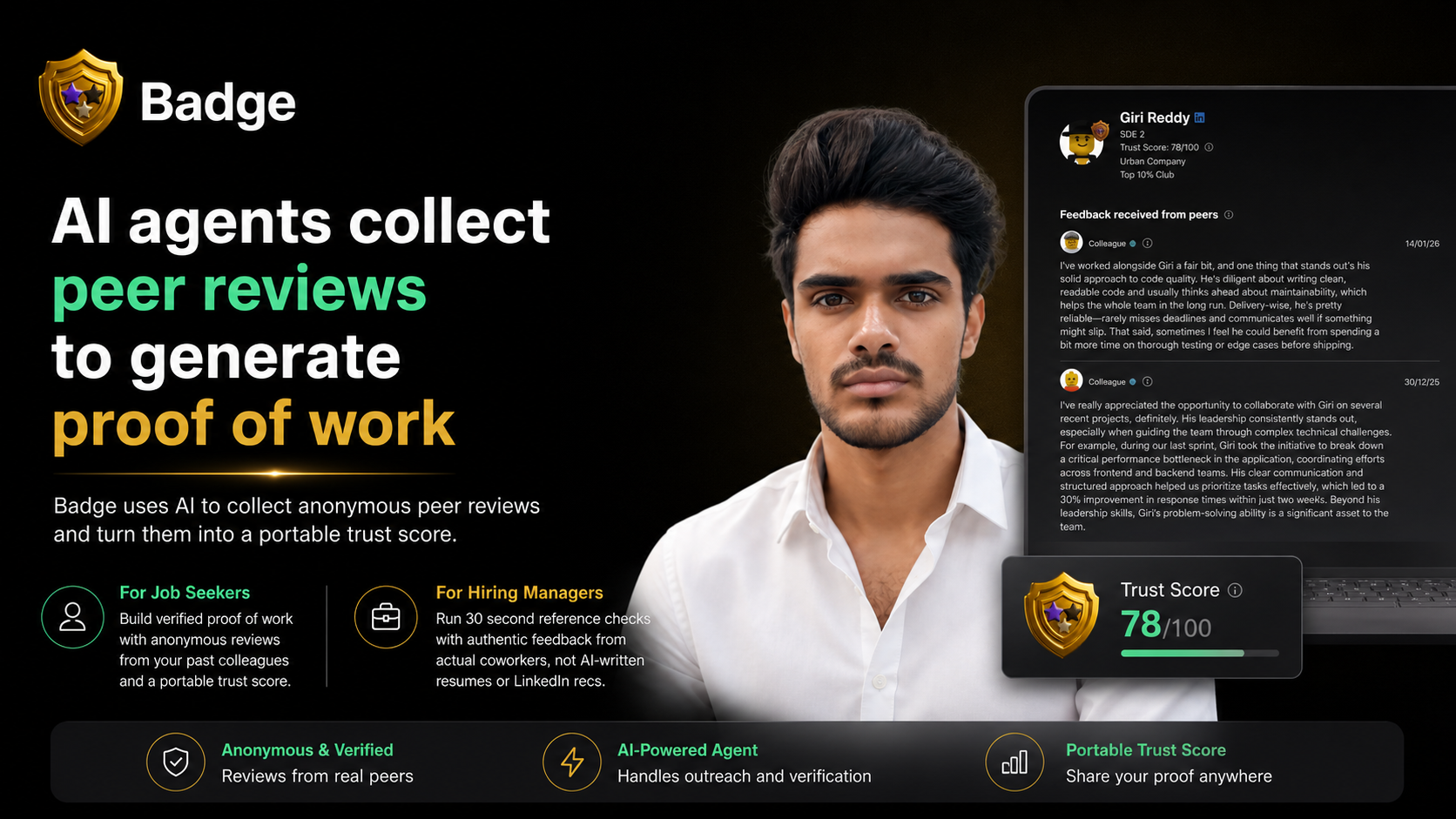
Badge is a platform built around a different kind of signal: peer feedback from people someone has actually worked with. It uses an AI agent to collect anonymous reviews from past colleagues and turn that feedback into proof of work. The result is a verified, portable trust score that job seekers can use across opportunities, while hiring managers can use Badge to complete faster reference checks.
The platform is available at https://getbadge.app.
What Is Badge?
Badge is a platform that gives users an AI agent designed to collect peer reviews. For job seekers, the agent connects to contacts, requests anonymous reviews from past colleagues, and uses those reviews to build a verified trust score. This trust score is meant to act as a portable proof of work that can travel with a person as they apply for roles or present their professional background.
For hiring managers, Badge is positioned as a way to run quick reference checks on candidates. Instead of relying only on resumes, profiles, or polished recommendations, the platform gathers feedback from people who have worked with the candidate directly. The idea is to make professional reputation more practical, structured, and easier to evaluate.
The Problem Badge Is Trying to Address
Modern hiring has become noisy. Many candidates have polished resumes, carefully written profiles, and publicly visible recommendations. With AI writing tools widely available, it has also become easier to generate professional-looking application materials that may not fully reflect real workplace performance.
At the same time, employers still need to understand practical questions such as:
- Was this person reliable in a real work environment?
- Did they collaborate well with others?
- How did past colleagues experience working with them?
- Can their work history be supported by credible feedback?
- Are there consistent patterns in how others describe their strengths?
Traditional reference checks can provide some of this context, but they often happen late in the hiring process. They may also depend on a small set of references, usually selected by the candidate. Badge takes a broader approach by collecting peer reviews from actual coworkers and organizing that feedback into a trust signal.
How Badge Works for Job Seekers
For job seekers, Badge provides an AI agent that reaches out to contacts and requests anonymous peer reviews. These reviews come from people the candidate has previously worked with, such as colleagues, teammates, or other professional contacts.
The feedback is then used to create a verified, portable trust score. The word “portable” is important because the score is not tied to one specific employer or application. It is designed to represent professional trust in a way that can move with the person as they explore new roles or opportunities.
In simple terms, Badge helps job seekers turn workplace relationships and past collaboration into a more structured form of proof. Instead of only saying what they have done, candidates can show that people who worked with them have provided feedback about their work.
What this can help communicate
A trust score based on peer reviews can provide a different kind of professional signal. It may help communicate:
- Credibility: Feedback comes from people connected to the candidate’s work history.
- Workplace reputation: Reviews can reflect how someone contributed in real working environments.
- Consistency: Multiple peer reviews may show patterns in how someone is perceived.
- Portability: The trust score can be used beyond a single job application.
This does not replace a resume, portfolio, interview, or work sample. Instead, it adds another layer of context around how someone works with others.
How Badge Works for Hiring Managers
For hiring managers, Badge offers fast reference checks on candidates. The platform is described as providing a 30-second reference check by collecting authentic feedback from a candidate’s actual coworkers.
This is meant to help hiring teams move beyond information that can be hard to verify. Resumes can be incomplete or overly polished. Online recommendations can be selective. Interviews can show how someone communicates in a short meeting, but they do not always reveal how that person performs over time.
Peer feedback can add useful context by showing how previous coworkers describe the candidate. Hiring managers can use this as one input in the hiring process, alongside interviews, portfolios, assessments, and role-specific requirements.
What hiring teams may look for
When reviewing peer-based feedback, hiring managers may be interested in signals such as:
- How consistently the candidate is described by past coworkers
- Whether feedback supports the experience shown on the resume
- How the person collaborated with teams
- Whether colleagues viewed the person as dependable
- What kind of work behavior appears across multiple reviews
These signals can help make reference checking more structured and less dependent on a few hand-picked conversations.
Why Anonymous Peer Reviews Matter
One notable part of Badge is that the reviews requested from past colleagues are anonymous. In professional settings, anonymity can change the quality of feedback. People may be more willing to share honest observations when their names are not directly attached to their comments.
This can be especially useful when the goal is to understand someone’s real working style. Public recommendations often focus on positive statements because they are visible and tied to someone’s name. Anonymous reviews may make it easier to gather broader and more candid feedback.
At the same time, anonymous feedback should still be interpreted carefully. Any review system depends on the quality, relevance, and fairness of the responses collected. Badge’s approach is to turn those responses into a verified trust score, but the score should still be understood as one professional signal rather than a complete picture of a person.
Proof of Work Beyond a Portfolio
The phrase “proof of work” is often used to describe evidence that someone can do what they claim. For designers, developers, writers, or creators, proof of work may come through portfolios, public projects, case studies, or samples.
Badge applies the idea more broadly by focusing on peer validation. Not every role produces public work that can be easily shown. Many professionals contribute through collaboration, operations, management, internal systems, communication, or team support. These contributions may be important, but they are not always visible in a portfolio.
By collecting reviews from coworkers, Badge creates a way to represent work that may otherwise stay hidden inside past organizations. This can be relevant for people whose professional value is strongly connected to trust, reliability, execution, and collaboration.
Where Badge Fits in the Hiring Process
Badge does not need to be seen as a replacement for existing hiring steps. It fits more naturally as an additional layer of verification and context.
A typical hiring process may still include:
- Reviewing a resume or profile
- Looking at a portfolio or work samples where relevant
- Conducting interviews
- Evaluating skills or role-specific experience
- Checking references
Badge focuses mainly on the reference and reputation side of this process. It can help make peer feedback easier to collect and review, especially when hiring teams want a faster way to understand how a candidate has worked with others in the past.
Things to Keep in Mind
As with any platform that collects professional feedback, there are a few practical points worth considering.
- Feedback quality matters: A trust score is only as useful as the reviews behind it.
- Context is important: Peer reviews should be considered alongside the role, team, and work environment.
- No single signal is complete: A trust score can add context, but it should not be the only basis for a hiring decision.
- Professional relationships vary: Different colleagues may have different experiences depending on the project or situation.
Used thoughtfully, peer review data can help bring more real-world context into professional evaluation. It is most useful when combined with other evidence of skills, experience, and fit.
Final Thoughts
Badge is an interesting example of how AI agents are being used in practical workplace processes. Instead of generating resumes or writing recommendations, Badge’s agent collects feedback from people who have worked with a candidate and turns that feedback into a portable trust score.
For job seekers, it offers a way to build proof of work through anonymous peer reviews. For hiring managers, it provides a faster method for reference checking by gathering feedback from actual coworkers. In a hiring environment where polished profiles and AI-generated application materials are becoming more common, tools that focus on verified professional feedback may become more relevant.
You can learn more about the platform at https://getbadge.app.